Non-Invasive Leak Detection: A Practical Home Guide
Learn safe, non-invasive leak detection techniques homeowners can use to locate hidden water leaks. This guide covers signs, tools, step-by-step methods, safety tips, and when to seek professional help—minimizing damage and reducing water waste.


By the end of this guide you will confidently perform non invasive leak detection at home, identifying hidden leaks in plumbing, appliances, and fixtures without destructive testing. You will learn signs to watch for, safe measurement tools, and a clear, step-by-step approach to verify findings and plan repairs, reducing water waste and damage.
What is non invasive leak detection?
Non invasive leak detection refers to locating leaks without opening walls, removing fixtures, or causing structural damage. It relies on tools and techniques that monitor water movement, moisture, temperature, or airflow to pinpoint the leak source from the outside of the structure. The aim is to identify leaks early with minimal disruption, reducing repair costs and avoiding unnecessary damage. According to Leak Diagnosis, implementing non-invasive methods first can save homeowners time and money and decreases the risk of secondary damage.
Common contexts for non-invasive detection include: plumbing behind walls or under slabs, leaks around appliances (dishwashers, washing machines, water heaters), fixtures (faucets and toilets), and roof leaks that manifest as attic humidity or damp spots. The detection process blends careful observation with measurements, using multiple methods to confirm a leak rather than relying on a single clue. This approach also helps homeowners document the problem for repairs and potential insurance claims.
Quick Signs You May Have a Hidden Leak
Common indicators include a dramatic rise in your monthly water bill without changed usage, damp patches on walls or ceilings, persistent musty odors, and unexplained sounds of running water. If you notice such signs, start with non-invasive checks before considering invasive inspections.
Pro tip: keep a log of readings from moisture meters or infrared scans to build a pattern over several days. This helps distinguish a one-off anomaly from a persistent leak. According to Leak Diagnosis, documenting trends is a powerful first step in locating concealed leaks without unnecessary demolition.
Tools & Materials
- Infrared/thermal imaging camera(Detects temperature differences that indicate hidden leaks behind walls or under floors)
- Acoustic leak detector(Helps hear running water behind surfaces when visibility is limited)
- Non-toxic dye for dye tests(Introduces color into suspected lines to visualize leaks in fixtures or supply lines)
- Moisture meter(Measures moisture levels in walls, ceilings, and cabinetry to map the extent of damp areas)
- Flashlight(Bright, reliable light to inspect dark spaces and tight corners)
- Protective gear (gloves/goggles)(Personal safety during testing and dye application)
- Optional tracer gas or smoke pen(Can help visualize airflow paths in hard-to-reach areas)
Steps
Estimated time: 60-90 minutes
- 1
Prepare the workspace
Clear the area around suspected leaks and ensure access to plumbing panels or fixtures. Shut off electrical devices nearby if you must work near water, and wear protective gear. Have your documentation ready so you can compare readings later.
Tip: Take photos before you start so you can track changes and communicate findings clearly. - 2
Perform a visual and environmental check
Survey ceilings, walls, floors, and cabinetry for stains, mold, or damp spots. Look for warped surfaces and musty odors that hint at concealed moisture. Note all areas that seem suspicious for further testing.
Tip: Pair visual signs with your moisture readings to avoid chasing false positives. - 3
Run non-invasive tests with thermal and acoustic tools
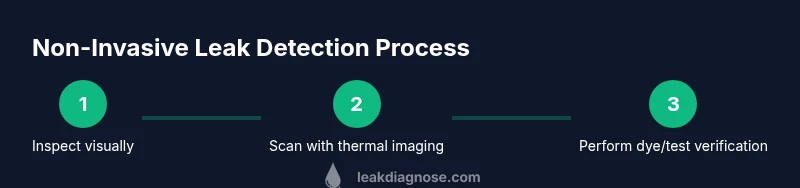
Use an infrared camera to identify temperature anomalies around suspected pipes and appliances. Employ an acoustic leak detector to listen for running water inside walls. Do not force access; rely on non-invasive readings.
Tip: Calibrate the camera distance to target areas and avoid reflections from shiny metal surfaces. - 4
Conduct a dye test or tracer test where appropriate
Introduce a safe dye into a fixture line or use a tracer gas in vented spaces to observe for dye appearance or gas movement. Stop the test if any safety concerns arise, and monitor readings closely.
Tip: Limit dye exposure to prevent staining, and test in well-ventilated areas. - 5
Cross-verify with moisture mapping and documentation
Take moisture readings in several points around the suspected area to map the extent of dampness. Compile readings and photos to create a leak map that guides repairs or professional evaluation.
Tip: If readings are inconclusive, step back and re-test after a short period to account for seasonal moisture changes.
Questions & Answers
What counts as non-invasive leak detection?
Non-invasive leak detection uses non-destructive methods to locate leaks, such as infrared imaging, acoustic listening, and dye tests, without tearing into walls or fixtures. It focuses on moisture, temperature changes, and airflow to pinpoint sources.
Non-invasive leak detection uses tools like infrared cameras and listening devices to find leaks without opening walls, helping you identify the problem safely.
When should I start with non-invasive detection?
Beginning with non-invasive methods is typically wise when you notice damp spots, higher water bills, or unexplained sounds. This approach minimizes damage, reduces repair costs, and helps determine whether invasive access is truly needed.
Start with non-invasive methods whenever you suspect a leak to avoid unnecessary demolition.
What tools are essential for non-invasive detection?
Essential tools include an infrared camera, an acoustic leak detector, a moisture meter, and a non-toxic dye test kit. A flashlight and protective gear complete the setup for safe, thorough investigation.
You’ll want an infrared camera, a moisture meter, and a dye test kit to map and confirm leaks safely.
Can non-invasive methods detect all leaks?
Non-invasive methods are highly effective for many common leaks but may miss some hidden or complex leaks behind multiple layers or in inaccessible spaces. In such cases, a professional assessment with invasive testing may be required.
Non-invasive methods work well for most leaks, but some situations may need a pro’s invasive checks.
When is it necessary to call a professional?
If moisture readings remain inconclusive after non-invasive testing, or if there’s significant structural damage, seek professional evaluation. They can perform advanced diagnostics and safe, compliant repairs.
If tests are inconclusive or you see structural damage, call a professional.
Are non-invasive tests reliable for appliance leaks?
Yes, non-invasive methods can identify leaks from appliances like dishwashers or water heaters by checking moisture around the appliance and using dye tests in supply lines. Some leaks may require appliance-specific diagnostics.
Non-invasive tests often reveal appliance leaks, but some cases may need appliance-specific checks.
Watch Video
Main Points
- Identify leaks using non-invasive methods first.
- Use a combination of thermal, acoustic, and moisture tools for accuracy.
- Document signs and readings to guide repairs and prevent damage.
- Start with safety and ventilation when using dye or tracer tests.
- If in doubt, consult a professional before invasive access.