Difference Between Leak and Leakage: A Clear Comparison
Understand the difference between leak and leakage in home plumbing. This analytical guide defines terms, shows usage patterns, and offers practical steps to prevent water damage while communicating clearly with professionals.


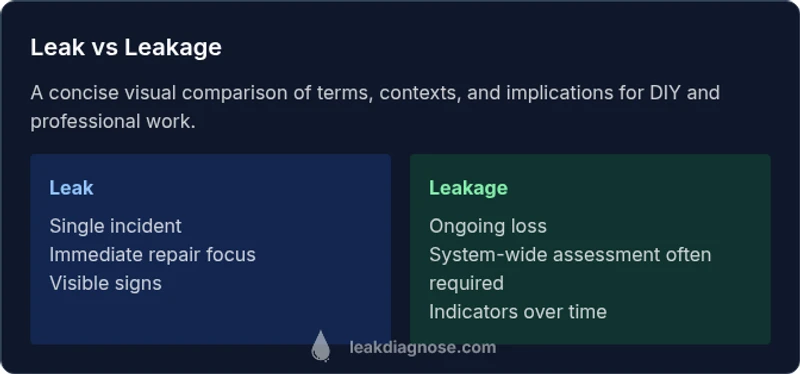
The difference between leak and leakage centers on usage and nuance: 'leak' refers to the presence or act of unintended water escape, while 'leakage' refers to the ongoing process or amount of water that escapes. In home plumbing, use 'leak' when reporting a specific incident and 'leakage' when describing the overall rate or extent of water loss.
Understanding the Core Terms: Leak and Leakage
The difference between leak and leakage is a semantic distinction that matters in both professional and domestic contexts. In everyday language, people sometimes use the terms interchangeably, but technical writers and plumbers prefer precise usage to avoid confusion. The word leak typically signals a discrete incident or a visible escape of water, such as a leak under a sink or a leak coming from a pipe. Leakage, on the other hand, conveys an ongoing process, level of escape, or cumulative water loss over time. For homeowners, grasping this distinction helps in describing issues accurately to a contractor and in assessing the urgency of repairs. In the literature and on plumbing forums, you will repeatedly see this distinction emphasized to prevent miscommunication that could delay a fix or inflate a bill. The phrase the difference between leak and leakage is not merely academic; it informs how you report, diagnose, and prioritize repair work.
Evolution of Terminology in Everyday Speech
Over time, language evolves with common usage. The terms leak and leakage reflect two different frames: a singular event and a broader phenomenon. For DIY enthusiasts, starting with clear language reduces back-and-forth with professionals and accelerates resolution. Leak tends to anchor discussions to a moment—an identifiable drop, a pooling area, or a sudden hiss of water. Leakage invites discussion about rate, duration, and potential hidden pathways that allow water to escape, possibly beyond the visible sign. By consciously choosing words, homeowners can guide the scope of inspection and avoid underestimating the problem. This alignment between language and reality is especially important when documenting the incident for your records or for insurance correspondence, where precision matters.
Practical Outcomes of Proper Terminology
Correct terminology affects several practical outcomes: it influences how quickly a problem is diagnosed, what tools or tests are used, and whether the issue is treated as a one-off incident or a recurring maintenance concern. When you tell a plumber you have a leak, you signal an immediate repair task. If you describe leakage, you invite a broader assessment of seals, joints, and potential corrosion. This subtle shift can shape your approach to fixes, including the choice between a quick seal versus a more comprehensive evaluation of water pathways. In short, learning the difference between leak and leakage is a practical skill that improves communication and outcomes at home.
Practical Steps for Homeowners: Language First, Action Second
Begin any report with a concise description: where the water is visible, when it started, and whether it is episodic or ongoing. Follow with a measurement of signs, such as puddling, dampness, or mold growth, and narrate changes over time. If you can quantify the rate of water loss without specialized equipment, do so using simple indicators (e.g., more moisture after rainfall or after running appliances). Finally, document actions taken and requests for inspection. This structured approach, paired with precise terminology, helps ensure that the right professional is engaged promptly.
Distinguishing Localized Leaks from Systemic Leakage
Localized leaks are localized failures: a drippy faucet, a pinhole in a copper line, or a valve that has failed. Leakage often involves seepage through porous joints or small fractures that allow water to escape gradually across a wider area or along a network of pipes. Recognizing whether you’re dealing with a simple leak or underlying leakage in a plumbing system guides decisions about repair scope, testing methods, and whether a replacement of fittings or piping is warranted. Clear language here reduces confusion and speeds up repairs.
The Role of Context: Appliances, Fixtures, and Structures
Leads and signs of leakage can arise from multiple sources: appliances (dishwashers, washing machines), fixtures (faucets, valves), piping (copper, PEX, PVC), and structural elements (walls, floors, ceilings). Distinguishing between leak and leakage in these contexts helps determine whether a quick fix (like replacing a rubber gasket) suffices or a more thorough investigation is required. For homeowners, this means prioritizing issues with visible water flow versus investigating hidden moisture that could indicate long-term damage.
How to Document and Communicate Clearly
When describing issues, start with the key observation (e.g., water dripping from a joint) and state whether it’s an instantaneous event or a sustained condition. Include timeframes, observable patterns, and any triggers (such as running the dishwasher). Clinically phrased notes help contractors assess risk and plan inspections without unnecessary back-and-forth. Remember to reference the terminology distinction: use 'leak' for a single incident and 'leakage' for ongoing escape or volume over time.
Summary of Practical Implications for DIY and Pro Guidance
Ultimately, the difference between leak and leakage influences the approach to repair. A leak often signals a targeted fix, whereas leakage suggests systemic issues that may require more extensive assessment. By mastering this terminology, homeowners can communicate more effectively, request appropriate diagnostics, and select repair strategies aligned with the actual problem. The result is faster resolution, better resource allocation, and reduced risk of recurring water damage.
What to Do Next: Quick Checklists for Homeowners
- Inspect obvious sources: faucets, hose connections, valves, and appliance water lines for leaks.
- Note whether moisture appears suddenly or gradually over days or weeks.
- Check nearby areas for signs of hidden leakage such as staining, mold, or warped materials.
- If in doubt, schedule a professional inspection and share your observations using precise terms.
- Keep a simple log of incidents to help track whether the issue is a one-time leak or ongoing leakage.
Comparison
| Feature | Leak | Leakage |
|---|---|---|
| Definition | A specific incident or moment of water escape | An ongoing process or rate of water escape |
| Context of Use | Describing a single event (e.g., a pinhole) | Describing the flow over time or volume lost |
| Repair Focus | Targeted fix for the incident | Broader assessment of plumbing system |
| Common Signals | Visible drip, puddle, sudden noises | Persistent dampness, increased humidity, recurring signs |
| Information Conveyed | Urgency and location of a single issue | Severity and potential systemic problems |
| Professional Implications | Short-term fix and documentation of the event | Comprehensive inspection and possibly replacements |
Benefits
- Improves communication with contractors
- Helps prioritize fixes and inspections
- Aids in documenting incidents for records
- Reduces ambiguity in home maintenance
- Supports better preventive planning
What's Bad
- Terminology can vary by region or profession
- Overemphasis on words may confuse non-specialists
- Not all scenarios fit neatly into one term
- Misuse can delay necessary repairs
Use precise terminology to speed up diagnosis and repair
Differentiating leak from leakage helps you report issues accurately, guiding the scope of inspection and the repair approach. Clear language reduces back-and-forth with professionals and can lead to faster, more effective fixes.
Questions & Answers
What is the difference between leak and leakage in plumbing?
In plumbing, a leak usually refers to a single or instantaneous escape of water, while leakage describes ongoing water loss or the rate at which water escapes. Understanding this helps you communicate the issue and determine the repair strategy.
A leak is a single incident of water escaping, whereas leakage describes the ongoing loss or rate of water escape. This distinction helps when talking to a plumber.
Can 'leak' and 'leakage' be used interchangeably?
They can be used interchangeably in casual speech, but in professional contexts they convey different meanings. Using the correct term helps contractors diagnose quickly and decide whether a quick fix or a broader inspection is needed.
They aren’t perfectly interchangeable in professional settings. Correct terms help plumbers assess the scope of the issue.
How do I tell if a drip is a leak or leakage?
If water drips intermittently from a damaged part, it signals a leak. If you notice sustained dampness, pooling, or water loss over days, that suggests leakage. Inspect and document timing and pattern for accurate reporting.
Look for a single drip versus ongoing dampness. Consistent moisture points to leakage, while a one-time drip is a leak.
Does insurance care about terminology?
Insurance reviews consider the cause and extent of water damage, not just the word used. Providing precise descriptions of leaks or leakage helps support claims and repair decisions.
Policies care about what happened and how severe it is, not the exact term. Clear descriptions help your claim.
When should I call a plumber?
Call a plumber when you observe persistent moisture, visible leaks, or signs of ongoing leakage that could indicate hidden damage. Early professional assessment reduces risk of mold and property damage.
Call a plumber if moisture sticks around or you see ongoing water loss. Early help saves hassle later.
Are there regional differences in using leak vs leakage?
Yes, some regions favor one term over another due to local dialects or professional conventions. When in doubt, describe the condition and consider providing pictures or measurements to avoid misinterpretation.
Regional terms vary, so focus on describing what you see and feel, not just the word.
Main Points
- Use 'leak' for a specific incident and 'leakage' for ongoing escape
- Describe location, time, and change over time when reporting issues
- Choose terminology that matches the scope of the problem
- Document signs and actions for faster contractor response