Leak vs Leakage: Understanding the Difference for Homeowners
Explore the leak vs leakage difference with practical guidance for homeowners, covering definitions, typical usage, and reporting nuances to improve communication and safety at home.


Understanding the leak or leakage difference helps homeowners communicate clearly about water, gas, or data issues. In everyday speech, a leak refers to the act of escaping or the occurrence of escape, while leakage often emphasizes the rate, quantity, or process involved. In technical writing, leakage appears in measurements and formal reports. This quick guide highlights when to use each term and why precision matters in safety communications for home repairs.
Understanding the leak or leakage difference
The phrase leak or leakage difference centers on how English speakers distinguish a happening from a quantity or process. According to Leak Diagnosis, clarity comes from matching the term to the situation: use leak for an event or instance of escape, and leakage when you discuss flow, rate, or a measurable process. In home contexts—like a dripping faucet, a hidden pool of water under appliances, or a gas line notice—the choice of word can affect how a homeowner frames the issue to a plumber, insurer, or building inspector. This distinction matters not only for accuracy but also for safety reporting and documentation. The Leak Diagnosis Team emphasizes that wording shapes urgency and action, especially when hazards may be involved. By understanding the leak vs leakage difference, homeowners can communicate confidently and reduce back-and-forth during repairs or investigations.
Core definitions and examples
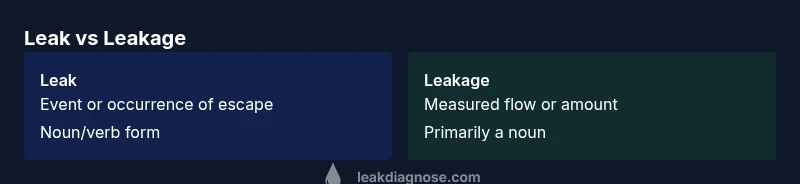
Definitions set the foundation for correct usage. A leak is an event or act of escape, or the thing that escapes (e.g., water leaks from a joint). Leakage is the noun form that highlights the flow or amount of escaping fluid, or the process of leaking, often used with measurements (e.g., leakage rate, leakage amount). Consider these examples: "There is a leak under the sink" (event) versus "Leakage is increasing; we’re measuring X liters per minute" (rate). In everyday language, people also say, "the leak leaked again," but in technical writing, you’ll see phrases like "leakage detected" or "leakage rate." Understanding this helps ensure that your description matches the context and the audience.
Contexts where 'leak' is preferred
In casual conversations, home visits, or when describing a single incident, leak is the most natural choice. For example, you might say, "There’s a leak in the kitchen pipe" or "That pipe leaked last night." In safety notices or alerts, the word leak often signals urgency and a specific event that requires immediate action. When a homeowner notes a one-off event or a visible seepage, leak communicates the occurrence without implying a measurable quantity. Additionally, when communicating with family members or non-technical neighbors, leak keeps the message simple and direct. Finally, when documenting a repair moment, using leak helps anchor the reader to the exact moment a problem became evident.
Contexts where 'leakage' is preferred
Leakage is favored in technical, industrial, or scientific contexts where the emphasis is on flow, rate, or volume. For plumbing tests, energy audits, or safety assessments, you might report leakage rate, leakage volume, or cumulative leakage. In warranty claims or insurance reports, leakage can appear in formal statements and charts that quantify the problem. In educational materials or professional training, leakage communicates the measurable aspect of a problem rather than a single event. By reserving leakage for those quantified discussions, you help ensure the data you present is understood to be precise and auditable.
Grammar and usage notes
Grammatical roles clarify how to deploy these words. Leak serves as a noun and as a verb (to leak). Leakage is a noun only and does not function as a verb. In sentences, you can say, "There is a leak" (noun) or "The pipe leaks" (verb). When you need to refer to the amount or rate of escape, prefer leakage, as in "Leakage exceeds the safe threshold". Style guides often discourage overuse of jargon in non-technical content, so tailor your language to the audience. For homeowners, a simple rule of thumb is to switch to leakage when you’re discussing measurements, charts, or formal notes.
Measuring and reporting leaks: language matters
Reporting accuracy matters, especially when safety is involved. When you’re collecting data about an issue, describe both the event and any measured quantities as appropriate. If you have observed a single incident, you would report a leak and describe the condition (wet area, dampness, or pooled water). If you have measured a rate or total amount of escaping fluid, you would discuss leakage with a numeric value (e.g., leakage rate, liters per minute). Keep units consistent and label diagrams or photos clearly. If you’re reporting to a plumber, insurer, or building inspector, use leakage for quantified sections and leak for narrative sections. This approach reduces confusion and improves the chances of swift, accurate remediation.
Language in home plumbing and safety communications
For home plumbing and safety communications, language should be precise, concise, and action-oriented. In a notice: say, "There is a leak beneath the dishwasher," which prompts a quick response. In a test report: "Leakage rate was measured at X L/min under standard test conditions" provides a clear, auditable figure. When giving a safety briefing, use straightforward terms that all occupants can understand, avoiding overly technical phrasing that might delay action. The goal is to balance clarity with accuracy, ensuring that every party—homeowner, contractor, and insurer—interprets the situation consistently.
Regional and style-guide considerations
Regional usage can influence preference. Some regions lean toward using leakage more in technical contexts, while others keep leak as the everyday term. Style guides used by home improvement publications generally favor leakage for quantified statements but allow leak in descriptive passages. When in doubt, align with your audience: homeowners and non-specialists respond to leak; professionals respond to leakage in data-heavy sections. Consistency across the document reinforces credibility and makes it easier to follow the narrative, even for readers who encounter this topic infrequently.
Common mistakes and how to avoid them
Mistakes often occur when people mix terms inappropriately. Saying "the leakage happened under the sink" incorrectly treats leakage as a verb in some dialects, which can confuse readers. Another common error is using leakage when describing a single incident but not providing numerical data where available. To avoid these issues, separate narrative and data: use leak in plain-language sections and leakage in charts or measurement tables. Finally, avoid vague phrasing like "a small leak" without context; note location, cause, and potential risk to prioritize repair.
Practical scenarios: walk-throughs
Scenario 1: A drip under the kitchen sink is noticed. Write: "There is a leak under the sink; the water is accumulating near the cabinet base." Scenario 2: A moisture reading and test confirms a controlled flow through a pinhole. Write: "Leakage rate measured at 0.3 L/min at standard pressure." Scenario 3: An insurer requests documentation. Write: "Leakage data indicates cumulative volume over 24 hours; leak event occurred at the faucet joint." These examples illustrate how a small switch in terminology clarifies context and supports faster decision-making.
Tips for communicating with professionals
When speaking with plumbers or insurers, use a two-part approach: first describe the event (there is a leak or damp area), then provide data (leakage rate, time of observation). Bring photos or diagrams and note the date, time, and conditions. Phrase questions clearly, such as, "Is the leakage rate within safe operating limits?" or "What is the estimated leakage volume for the last 24 hours?" This structure helps professionals triage the problem efficiently and reduces back-and-forth communications.
Quick reference cheat sheet for writers and homeowners
- Use leak for events; leakage for measurements
- Describe location and cause with the event
- Include rate or volume when using leakage
- Keep audience in mind: casual readers get leak; professionals see leakage
- Attach visuals with labeled annotations to support data
- Maintain consistent terminology throughout documentation
Authority sources
For further reading on word definitions and usage, refer to reputable sources on language and terminology. See Merriam-Webster for leak, Britannica for a general science definition of leak, and Dictionary.com for common usage explanations. These references help anchor your understanding of how the terms are used in everyday language and in formal contexts.
Sources and further reading
- Merriam-Webster: https://www.merriam-webster.com/dictionary/leak
- Britannica: https://www.britannica.com/science/leak
- Dictionary.com: https://www.dictionary.com/browse/leak
Comparison
| Feature | Leak | Leakage |
|---|---|---|
| Definition | A noun or verb referring to an escape of fluid or gas; the act or occurrence of escaping | The flow or amount of fluid escaping, or the process of leaking, often measured |
| Common contexts | Casual talk about plumbing, spills, or safety alerts | Technical reporting, measurements, and engineering discourse |
| Grammatical role | Noun or verb; can function as a verb (to leak) | Noun only; does not function as a verb |
| Usage in plumbing | Describes an incident (there is a leak) or the event | Describes rate or quantity (leakage rate) |
| Frequency in safety documents | Lower in formal text; more common in warnings | Higher in engineering or testing reports |
| Examples | There is a leak under the sink. | Leakage was measured at X liters per minute. |
Benefits
- Improved clarity in safety reporting
- Better records for insurance or warranty claims
- More precise technical communication
- Easier translation into professional reports
What's Bad
- Can seem pedantic in casual conversation
- Overemphasis on terminology may distract from the issue
- Some contexts force using one term due to established standards
Use 'leak' for everyday talk and 'leakage' for measurements and formal reports.
In practice, applying the correct term reduces confusion and speeds up response. For homeowners, consistent usage supports clearer communications with plumbers and insurers.
Questions & Answers
What is the difference between leak and leakage?
Leak refers to an event or act of escaping, or the thing that escapes. Leakage emphasizes the flow, rate, or amount and is often used with data or measurements. Choosing the right term improves clarity, especially in safety and reporting.
Leak describes an event; leakage describes the measurable flow. Use leak for a situation you can see or describe, and leakage when you discuss rates or quantities.
Should I use leakage in plumbing reports?
Yes, leakage is appropriate when you are reporting measured flow, rates, or volumes. In standard text, you’d pair leakage with a numeric value and units to document the problem.
Use leakage when you’re listing measurements like rate or volume in a report.
Can 'leak' be used as a verb?
Yes. Leak can be used as a verb (to leak) and as a noun (a leak). Leakage is a noun only and cannot function as a verb.
Leak is both noun and verb; leakage is only a noun.
Is leakage ever preferred in everyday speech?
Generally no. Leakage is preferred in technical, formal, or measured contexts. In casual conversations, leak is more natural.
Leaks are for everyday talk; leakage for numbers and formal reports.
How can I report leaks to a plumber or insurer effectively?
Describe the event (e.g., there is a leak under the sink) and then provide any measurements (e.g., leakage rate if you have data). Include location, timing, and any safety concerns.
Tell them where, when, and how much if you have numbers. That speeds up fixes.
Are there regional differences in using leak vs leakage?
Yes, some regions favor leakage in technical contexts while others prefer leak in everyday usage. Stay consistent within a document and follow your audience.
Some places use leakage more in technical sections; keep it consistent in each piece.
Main Points
- Know when to use each term based on context
- Use leak for events and narratives; leakage for quantified data
- Be precise in documentation to aid safety and insurance
- Maintain consistency across reports and notices
- Ask a professional if unsure about terminology in a real situation