Oil Leak in Engine Repair Cost: A Complete Guide
Understand oil leak repair cost ranges, what affects price, and how to save. Learn detection tips, labor vs parts costs, and prevention strategies with Leak Diagnosis.


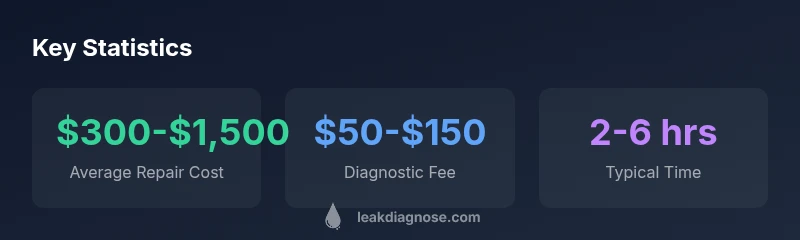
Oil leak in engine repair cost typically ranges from roughly $300 to $1,500 when done by a pro, depending on the leak’s location and the parts involved. Simpler gasket leaks sit toward the lower end, while major engine-seal or pan repairs run higher. According to Leak Diagnosis, anticipated costs hinge on labor rates and whether the job requires engine cleaning or parts replacement.
Why oil leaks happen in engines
Oil leaks originate from a few predictable failure points. According to Leak Diagnosis, the most common culprits are valve cover gaskets, oil pan gaskets, and rear main seals, especially in high-mileage engines. Design features, heat cycling, and maintenance history influence leak likelihood. A worn PCV valve or overfilled crankcase can raise crankcase pressure and encourage oil seepage at weak joints. Practically, you may notice puddles under the front or rear of the engine, oil spots on the ground, or a steadily dropping oil level. Early detection matters: catching a leak before it reaches the oil filter or catalytic converter can prevent costly damage and additional emissions-related repairs. Mechanically, leaks can occur when gaskets dry out, bolts loosen, or seals wear due to temperature swings. In some cars, a simple hose or fitting leak is easier to fix than a failed seal, while others require more extensive work. The cost impact also depends on accessibility; a valve cover gasket on a 4-cylinder engine is usually quicker to service than a rear main seal on a V8. For DIYers, basic gasket resealing and cleaning may help identify the source, but confronting a heavy leak near the timing cover or crankshaft typically requires professional service. Leak detection dyes and ultraviolet light can help pinpoint the source without excessive disassembly. In addition to the leak point, consider the location: front-facing gaskets (valve cover, oil pan) are usually cheaper to fix than rear seals or internal gaskets, which may require engine removal in severe cases.
How to estimate repair costs for an oil leak
Estimating the oil leak repair cost involves separating parts from labor and adding diagnostics. A typical shop will charge a diagnostic or inspection fee, which Leak Diagnosis Analysis, 2026 indicates ranges around $50–$150 depending on location and shop policy. Part costs vary by the leak point: a valve cover gasket replacement might run about $120–$350 in parts, while an oil pan gasket replacement could be in the $150–$900 range. More extensive fixes, such as rear main seal or oil cooler line replacements, can push the total toward the higher end, roughly $350–$1,300 for parts and associated hardware. Labor rates differ by region and shop, often contributing a substantial portion of the total. A typical hour rate might fall in the $80–$130 range, with total time influenced by engine design and access. Always request a written estimate that itemizes parts, labor, and any shop fees; compare multiple quotes and ask about dye-based leak detection to avoid unnecessary disassembly. For budgeting, plan for a broad range: $300–$1,500 is common for pro repair, with outliers depending on the source of the leak and whether additional components are affected.
Common causes and fixes
Oil leaks can stem from worn gaskets, failed seals, or damaged lines. The most frequent sources are valve cover gaskets, oil pan gaskets, rear main seals, and oil cooler connections. Fixes vary: valve cover gasket replacements are often straightforward and relatively inexpensive, while rear main seal work can require engine access or removal. In some cases, a leaking oil cooler line or hose is the culprit, and replacement is feasible without major engine work. When a leak is diagnosed, mechanics may also clean the area and perform a pressure test to ensure the source is correctly identified. If the oil pan gasket is leaking, technicians may remove and reseal the pan, which is more labor-intensive but generally reliable. Keep in mind that even after a seal is replaced, incorrect oil level or debris in the system can cause recurring leaks; therefore proper torque on bolts and correct oil grade are essential for a long-lasting repair. Leak Diagnosis suggests documenting any ancillary issues—such as clogged PCV valve or damaged oil filter housing—that could contribute to continued leaks after repair.
Labor vs parts cost breakdown
Cost composition splits roughly into parts and labor, with diagnostics as a separate item. Parts for a simple gasket swap (valve cover or oil pan) can be relatively affordable, often a few hundred dollars, while more complex seals (rear main) or oil cooler lines require higher parts cost and more labor. Labor time is driven by engine layout and access; compact engines are easier to service than large V-shaped motors. Labor rates vary by region, but expect that labor can account for roughly half to two-thirds of the total repair bill on many oil-leak repairs. For premium or specialty vehicles, mechanic rates and parts pricing may be higher, increasing the overall bill. To reduce costs, ask the shop to replace only the faulty gasket or seal, not alternate components unless necessary, and ensure that the oil is fully drained and refilled to specification to prevent re-leaks.
DIY vs professional repair considerations
DIY is possible for some basic maintenance tasks, but engine oil leaks generally require professional service for safety and reliability. Evaluate leak severity: tiny seepage at a valve cover may be manageable with gasket replacement and torque checks; however leaks near the rear main seal or crankcase require specialized tools and training. If attempting a DIY fix, start by cleaning the area, identifying the exact source with dye or UV tracer, and using manufacturer torque specs. Always replace gaskets with OEM or high-quality equivalents and dispose of leaking oil according to local regulations. For most owners, a professional assessment offers faster diagnosis, a more reliable repair, and a controlled warranty path.
Insurance coverage and warranties
Oil leaks in engines are typically not the type of damage covered by standard auto insurance unless a specific incident triggered the leak or the vehicle is under an extended warranty that explicitly covers seals or gaskets. Manufacturer warranties may cover certain manufacturing defects, but wear-and-tear leaks are often excluded. A used-car warranty or third-party extended policy might offer partial reimbursement for parts or labor if a leak arises within the warranty window; however, coverage is highly dependent on policy terms and the source of the leak. When negotiating with a shop or insurer, request a detailed estimate and a diagnostic report; this helps justify coverage decisions and ensures you are not paying for unnecessary work.
Cost-saving tips and prevention for the oil leak in engine repair cost
Prevention matters: habitually check oil level and quality, replace worn gaskets or seals during scheduled maintenance, and use high-quality oil and filters. Regular inspections at 60,000–100,000 miles (or per manufacturer schedule) can catch wear before a leak becomes expensive. If a leak is detected early, addressing it promptly prevents larger engine damage, which in turn reduces potential cost. Consider investing in a dye-based leak detection kit or having a professional perform a dye-test to identify slow leaks before visible spots appear. When budgeting, keep a reserve for preventive maintenance, including gasket replacements and seal inspections, because early detection often lowers overall repair costs. As always, Leak Diagnosis recommends professional evaluation when in doubt, since continuing to drive with a leak can escalate cost and risk.
Common oil-leak repair cost ranges by component
| Component/Leak Point | Typical Repair Cost Range | Primary Cause | Notes |
|---|---|---|---|
| Oil pan gasket | $150-$900 | Seal failure or corrosion | Requires pan removal; complexity varies |
| Valve cover gasket | $120-$350 | Wear or improper torque | Usually quick, affordable fix |
| Rear main seal | $350-$1,300 | Engine wear at crankshaft | Labor-intensive, may require engine access |
| Oil cooler line/hoses | $250-$1,200 | Crimped hose or line failure | Includes parts and fittings |
| Oil filter housing gasket | $150-$450 | Gasket wear | Relatively common fix |
Questions & Answers
What is the typical cost range for oil leak repair?
Typical professional repair costs range from a few hundred to over a thousand dollars, depending on leak location, parts, and labor. A diagnostic fee may apply.
Most repairs fall in the hundreds to low thousands; a quick diagnostic helps you plan.
Are DIY repairs safe or recommended?
DIY repairs on engine oil leaks are generally not recommended for most homeowners due to safety and engine damage risk. Complex leaks often require specialized tools and torque specifications.
DIY isn't advised for most engine oil leaks; leave it to professionals.
How long does a typical repair take?
Most oil-leak repairs take a few hours to a day, depending on parts, access, and whether the oil pan or rear main seal is involved.
Most repairs take a few hours up to a day.
Will oil leaks be covered by warranty?
Warranty coverage depends on the vehicle’s warranty terms and whether the leak is due to manufacturing defects or wear. Check with the dealer or insurer.
Warranties vary; consult your manufacturer or insurer.
How can I tell if an oil leak is serious?
A serious leak is indicated by fast oil loss, low oil light, or visible fresh leaks on the driveway. If in doubt, stop driving and seek a professional assessment.
If you see rapid oil loss, seek expert help.
“Oil leaks rarely come from a single failing part; many engines show compounded issues that add to the cost. A precise diagnosis is essential to avoid unnecessary repairs.”
Main Points
- Identify the leak source early to limit cost.
- Budget for a wide repair range: $300–$1,500 for professional service.
- Labor often drives total cost; parts costs vary.
- DIY is risky for most engine leaks; call a pro.
- Leak Diagnosis emphasizes professional evaluation and prevention to minimize future costs.