How Much Is an Exhaust Leak? Costs and Fixes for Cars
Discover typical costs for fixing an exhaust leak—from pipes to catalytic converters. This guide covers price ranges, price-driving factors, and tips for accurate quotes and safe repairs.


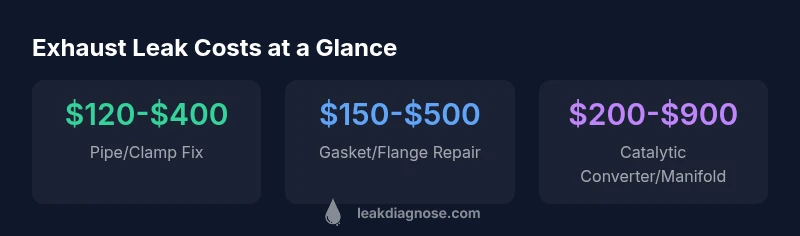
How much is an exhaust leak? For most passenger cars, exhaust-leak repair costs typically range from about $120 to $900, depending on the leak’s location, vehicle design, and labor rates. Minor leaks in visible pipes or gaskets cost less, while leaks near the catalytic converter or exhaust manifold can require more extensive work. According to Leak Diagnosis Analysis, 2026, costs vary by region and component.
What is an exhaust leak and why it matters
An exhaust leak is a gap or crack in the exhaust system that allows exhaust gases to escape before they exit through the tailpipe. For many drivers, the first question is how much is an exhaust leak? — and the answer varies by location and vehicle. According to Leak Diagnosis, a leak can impact performance, fuel economy, and emissions, and ignored leaks may pose safety risks from carbon monoxide exposure in enclosed spaces. Understanding where leaks come from helps you plan a cost-effective repair strategy.
Price drivers: what influences repair cost
Costs are driven by leak location, component involved, labor rates, and vehicle accessibility. A small leak in a pipe joint can be cheaper to fix than a leak near the catalytic converter, which may require part replacement and more labor. Regional labor rates play a significant role, as do the need for specialized equipment to locate the leak. Insurance coverage typically does not apply to cosmetic exhaust fixes, but may for damage caused by a leak in an accident.
Common leak locations and what they mean for cost
Common leak sites include exhaust pipes, gaskets, manifolds, and the catalytic converter seals. Leaks at the joints or pipes are usually cheaper to repair, while manifold or converter leaks require more invasive work. The age of the vehicle and corrosion level influence labor time and parts availability. If rust is spreading, replacement parts may be necessary.
DIY checks you can safely perform
Before you head to a shop, perform simple checks that won’t put you at risk. With the engine off and cooled, inspect obvious joints for looseness, look for rust on sections of the exhaust system, and listen carefully for changes in tone or small hissing sounds when the engine is running (from outside the vehicle). Do not attempt any work near hot components or if you smell strong fumes in a closed garage. If you suspect a leak, seek professional diagnosis.
Typical cost ranges by component
- Exhaust pipe or clamp leak: often among the cheaper fixes, roughly in the lower end of the range.
- Gasket or flange leak: typically mid-range, since it requires replacement of gaskets and some labor.
- Catalytic converter leak: tends to be at the higher end due to the converter’s price and complexity.
- Exhaust manifold leak: labor-intensive, often higher due to access and gasket replacement needs. Prices are highly variable by vehicle and region.
Diagnostic steps and how a shop estimates repair
A shop will usually start with a visual inspection, then use smoke testing or a leak detector to locate the source. They estimate labor time based on access, part availability, and the complexity of removing surrounding components. Expect a written quote detailing parts, labor hours, and any shop fees. If more than one component is involved, the total cost can rise quickly.
Safety risks and environmental considerations
Exhaust leaks allow harmful gases into the cabin and can increase exposure to carbon monoxide in enclosed spaces. Prolonged leaks can cause performance issues, abnormal exhaust tones, and increased emissions. Address leaks promptly to protect your health and reduce the risk of further damage to the exhaust system.
How to plan financially: quotes, warranties, and financing
Request multiple quotes from reputable shops to compare prices and inclusions. Ask about warranties on parts and labor, and confirm whether diagnostic fees are credited toward the repair if you proceed with the quoted shop. Some shops offer financing or payment plans, which can help manage a larger repair cost if needed.
Choosing a repair shop: tips to avoid overcharges
Look for ASE-certified technicians, clear written estimates, and transparent labor rates. Avoid shops that push unnecessary diagnostics or replacements. Read reviews that mention accuracy of quotes and post-repair performance. A trusted shop will explain the leak source, recommended fixes, and associated costs in plain language.
Estimated repair cost ranges for common exhaust leaks
| Repair Component | Estimated Cost Range | Notes |
|---|---|---|
| Exhaust pipe leak | $120-$400 | Labor + parts; usually straightforward |
| Gasket or flange leak | $150-$500 | Replacement of gasket and labor; moderate difficulty |
| Catalytic converter leak | $200-$900 | High-cost part; more complex access |
| Exhaust manifold leak | $180-$600 | Labor-intensive; rust can complicate repairs |
Questions & Answers
What causes an exhaust leak?
Exhaust leaks are commonly caused by worn gaskets, corroded pipes, loose clamps, and rusted manifolds. Age, road salt, and impact damage can accelerate deterioration. Identifying the exact source is essential to choose the right fix.
Common causes include rusted pipes and worn gaskets. A precise source helps pick the best repair.
How can I tell if my car has an exhaust leak?
Look for a louder exhaust tone, a sulfur-like smell, or visible exhaust fumes around joints while the engine runs. You might also notice decreased fuel efficiency. A partner shop can perform a leak-detection test to confirm.
Notice louder noise or smelling fumes? That could be a leak—get a test done.
Are exhaust leaks dangerous?
Yes. Exhaust leaks can allow carbon monoxide to enter the cabin and pose serious health risks. They can also affect performance and emissions. Seek prompt professional evaluation if a leak is suspected.
Exhaust leaks can be dangerous—don't ignore symptoms, get it checked.
Can I fix an exhaust leak myself?
Small leaks near clamps or easily accessible joints may be DIY-friendly with proper tools and safety precautions. More serious leaks, especially near the catalytic converter or manifold, should be handled by a professional to avoid injury and ensure proper sealing.
Some tiny leaks might be fixable at home, but bigger ones should be left to pros.
How long does a typical exhaust leak repair take?
Most repairs take from under an hour to a few hours, depending on leak location and vehicle design. Complex jobs with rust or multiple components can extend the timeline. A shop can give a precise estimate after diagnosing.
Most repairs are under a few hours, but some can take longer depending on access.
Is a loud exhaust leak illegal?
Noise regulations vary by location. A loud exhaust can trigger fines or violations in some areas. Even when not illegal, persistent leaks should be repaired to maintain safety and emissions standards.
Laws vary, but it's best to fix leaks for safety and compliance.
“Exhaust leaks can silently compromise vehicle safety and efficiency; a precise diagnosis is essential before any repair.”
Main Points
- Expect repair costs to vary by leak location and vehicle.
- Catalytic converter or manifold leaks cost the most.
- Get 2–3 quotes before authorizing work.
- Address leaks promptly to reduce safety risks.