Exhaust Leak Repair Cost Guide: 2026 Estimates & Tips
Learn how much it costs to fix an exhaust leak, including typical ranges, factors driving price, and money-saving tips from Leak Diagnosis. Practical guidance for homeowners and DIYers.


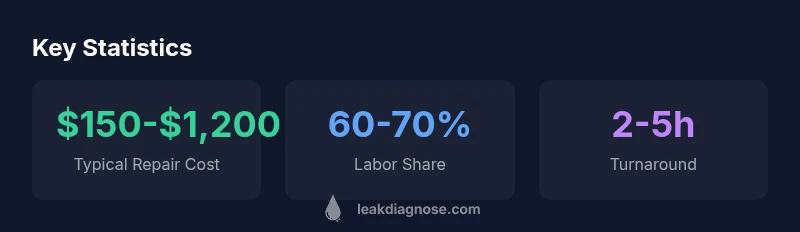
How much does it cost to fix an exhaust leak? The answer varies by vehicle, location, and leak source, but typical repairs run roughly from $150 to $1,200. Labor often dominates total costs, especially for catalytic converter or pipe replacements. Always get a written estimate and ask for a parts-vs-labor breakdown. Fuel economy and emissions tests can add to the cost in some cases.
Understanding the scope of an exhaust leak repair
An exhaust leak occurs when exhaust gas escapes through a gap, hole, or faulty seal in the exhaust system. Costs to fix it are influenced by the leak’s location (manifold, catalytic converter, pipe, gasket), accessibility, vehicle make and model, and regional labor rates. The question of how much it costs to fix an exhaust leak is not one-size-fits-all; even minor gasket leaks can require only simple parts, while more complex failures demand substantial labor and sometimes replacement components. For many drivers, early detection and timely repair save money by avoiding catalytic converter damage or emissions failures. Expect costs to scale with the complexity of the repair and the required safety checks, such as leak tests after repair.
As a baseline, most customers see a cost spectrum that starts at a few hundred dollars for minor gasket or clamp fixes, and climbs into the high hundreds or low thousands if the leak involves critical components or the entire exhaust path. In practical terms, the cost to fix an exhaust leak reflects both the price of parts and the labor time needed to access the affected area, replace worn components, and verify the fix with a test.
According to Leak Diagnosis, the variability is driven by two big factors: the type of leak and the labor market in your area. A tiny gasket leak might cost a few hundred dollars, while a leak near the catalytic converter or a full pipe replacement can push total costs higher. Emissions-testing requirements in some regions can also add a small, predictable expense to ensure the vehicle meets standards after repair.
Factors that influence total cost
Costs for exhaust leak repair are not uniform across all vehicles or shops. The primary cost drivers include the leak source, the extent of damage, part availability, and the labor rate in your locale. If the leak is at a simple gasket or clamp, the repair might be affordable and quick. More extensive problems—such as a hole in the exhaust pipe, damaged resonator, or a catalytic converter leak—often require more hours of labor and sometimes more expensive parts. Regional differences in labor rates can swing final bills by a noticeable margin. Vehicles with tight undercarriage spaces or aluminum components can require extra time and care, further raising costs. A well-prepared shop will provide a written estimate detailing parts, labor, disposal fees, and any safety testing.
Beyond the raw price, consider the long-term costs of not repairing promptly: unaddressed leaks can worsen engine performance, raise fuel consumption, and trigger emissions tests or failed inspections. If your vehicle is still under warranty, certain repairs may be covered, reducing your out-of-pocket expense. For homeowners evaluating home-vehicle DIY options, the advice from Leak Diagnosis is to assess your skill level, obtain the right tools, and avoid shortcuts that could compromise safety or emissions compliance.
Practical steps to keep costs reasonable include seeking multiple estimates, asking for a breakdown of parts versus labor, and inquiring about remanufactured or aftermarket parts where appropriate. A small leak fixed early can prevent larger, more expensive problems later, particularly in vehicles with advanced exhaust systems.
Common repair scenarios and their price ranges
Exhaust leaks can occur at different points, and the repair cost varies with the scenario:
- Gasket or clamp fix: In many cases, fixing a gasket or tightening a clamp is the least expensive option, typically falling in the lower end of the cost range.
- Pipe or section replacement: A hole or crack in a pipe or a corroded section may require replacing a short length of pipe, which increases labor time and parts cost.
- Catalytic converter leak: A leak around the catalytic converter area can be more expensive due to the converter’s value and the complexity of access.
- Full exhaust system replacement: This is the most extensive option and usually commands the highest price, reflecting parts and labor across multiple components.
To give a practical frame of reference, the typical repair cost bracket for exhaust leaks commonly spans from a few hundred dollars to over a thousand, depending on the repair type and vehicle. The best approach is to obtain a few written estimates and compare the scope of work, parts quality, and post-repair testing commitments. Leak Diagnosis emphasizes asking for a post-repair exhaust leak test to confirm the fix.
A note on DIY: While some minor fixes can be attempted by confident DIYers, professionals should handle leaks near engines, catalytic components, or places requiring cutting and welding, due to safety and environmental concerns. Always prioritize proper ventilation, PPE, and a test after repair to ensure no residual leaks remain.
How to get a reliable estimate
Before agreeing to any service, request a written estimate that itemizes labor hours, hourly rate, parts, and any disposal or shop fees. Ask vendors to specify whether the quote covers diagnostic time, a leak test, and post-repair verification. If you’re unsure about the leak source, request a diagnostic fee that is waived if you proceed with the repair at the same shop. Gather consistent quotes so you can compare apples to apples.
When reviewing estimates, look for a clear delineation between parts and labor. Some shops offer a flat diagnostic fee plus an hourly rate, while others bill by the hour with a materials multiplier. If possible, ask about warranty coverage on the repair and whether the parts are OEM or aftermarket. A reputable shop should be able to explain the reason for any added costs and provide a written plan for the repair, including testing to confirm the leak is fixed.
As you plan financially, consider potential ancillary costs like emissions testing or a vehicle inspection, which may be required in your state after a repair. By planning ahead and obtaining multiple estimates, you can better gauge the true cost of fixing an exhaust leak and avoid price surprises at checkout.
DIY vs pro: When to fix yourself
DIY repairs can be tempting when the leak is minor and easily accessible, such as a loose clamp or gasket. If you have a basic mechanic’s toolkit and a good set of safety practices, you may save on labor and still complete a satisfactory fix. However, more serious leaks near heat-sensitive components, catalytic converters, or welded joints usually require professional service. Welding and cutting exhaust pipes demand specialized equipment and expertise to prevent gas leaks and ensure safe operation.
If you’re considering a DIY approach, start with a precise inspection to confirm the leak location. Use a smoke test or soapy water for a quick leak check after reassembly. Remember that improper repairs can lead to dangerous exhaust fumes entering the cabin or causing emissions issues.
The Leak Diagnosis stance is that DIY can be appropriate for very small clamps or bolt-tightening tasks, but for anything involving structural changes, heat exposure, or emission-related components, seek a certified professional. This helps protect your vehicle’s performance, safety, and resale value.
Red flags that can increase costs
Several warning signs can escalate repair costs: corrosion that requires cutting or removal of parts, damage to the catalytic converter shell, hidden leaks that are difficult to access, and parts on backorder. If the leak is located in a high-risk area near the engine or pre-cat or post-cat systems, labor time increases due to the need for careful handling and safety checks. Similarly, if diagnostic work reveals additional unrelated issues, the total bill can rise significantly. In such cases, asking for a staged repair plan can help manage costs and minimize downtime while ensuring safety and compliance.
Another cost factor is the vehicle’s make and model. Some vehicles use proprietary fasteners or parts that are more expensive or require dealer-only service. When planning, factor in possible upcharges for working around delicate components, and ensure the shop tests the system after repair to verify seal integrity and emission performance.
When to consider replacement vs repair
In some cases, repairing the exhaust system may not be the most cost-effective option. If multiple sections are severely corroded, the pipes are thinning, or the catalytic converter is compromised, replacement may offer better long-term reliability. A complete exhaust system replacement typically carries a higher upfront cost but can extend the vehicle’s life and reduce the risk of repeated leaks. When evaluating replacement versus repair, consider the vehicle’s age, mileage, desired remaining lifespan, and potential future repair needs. A professional shop can provide a cost-benefit analysis and help you decide whether repair or replacement delivers better value over the next few years.
Cost ranges by repair type (Leak Diagnosis Analysis, 2026)
| Repair Type | Typical Cost Range | Labor Hours | Notes |
|---|---|---|---|
| Gasket/Joint repair | $150-$350 | 0.5-2 hours | Common DIY-friendly fix |
| Pipe/Section replacement | $300-$600 | 1-3 hours | Moderate complexity |
| Catalytic converter leak repair | $400-$1,100 | 2-5 hours | High-cost repair |
| Complete exhaust system replacement | $1,000-$1,800 | 3-8 hours | Most extensive fix |
Questions & Answers
What factors influence exhaust leak repair cost?
Costs are driven by leak source, repair complexity, parts quality, and regional labor rates. More complex repairs near the catalytic converter or engine typically cost more and require more time. Always compare multiple written estimates to understand the full scope of work.
Costs depend on the leak source, repair complexity, and local labor rates. Get multiple written estimates to compare scope and price.
Can I patch an exhaust leak myself to save money?
DIY work is feasible for simple fixes like a loose clamp or gasket, but risks include leaks, emissions failures, and unsafe fumes. If you’re unsure, seek professional help for safety and compliance.
DIY can work for small fixes, but safety and emissions are important—when in doubt, get a pro.
Do dealerships charge more than independent shops for exhaust leaks?
Dealerships can be pricier due to labor rates and OE parts, but they may offer OEM parts and warranty coverage. Independent shops often provide competitive pricing and personalized service. Obtain written quotes from both to compare.
Dealerships usually cost more, but you may get OEM parts with warranties. Check quotes from both to compare.
Will insurance cover an exhaust leak repair?
Most standard auto policies do not cover routine repairs like exhaust leaks. Some coverage may apply for damage from an accident. Check your policy or talk to your insurer for specifics.
Exhaust leak repairs aren’t usually covered unless related to an accident or comprehensive damage—check with your insurer.
How long does an exhaust leak repair typically take?
Most repairs take a few hours, but some complex fixes can require a full day. Schedule a window that includes diagnostic checks and a post-repair test.
Most repairs take a few hours, but complex fixes can take longer. Plan for diagnostic and test time.
Are there cheaper alternatives like used parts?
Used or remanufactured parts can lower costs but may carry higher risk of wear or shorter remaining life. Ensure parts have warranties and are suitable for your vehicle.
Used parts can save money but check warranties and compatibility before buying.
“Exhaust leak repairs require careful diagnosis to prevent dangerous emissions and ensure safe operation. Timely fixes save money over the long run.”
Main Points
- Get a written estimate before work.
- Labor often drives total cost.
- Minor fixes are cheaper than full replacement.
- Ask for parts vs. labor breakdown.