Cost to Fix AC Leak: A Homeowner's Guide to Pricing and Projects
Learn how the cost to fix ac leak varies in 2026, with price ranges, key factors, typical scenarios, and budgeting tips to help homeowners get accurate quotes.


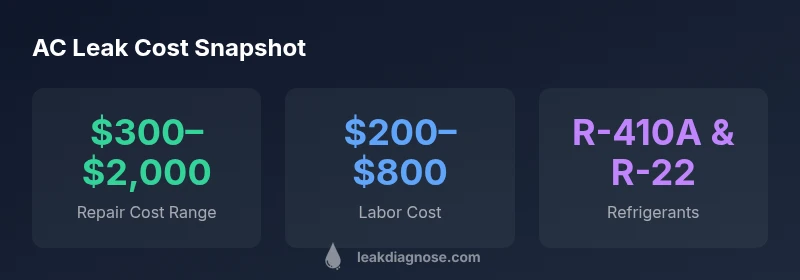
AC leak repair costs typically range from $300 to $2,000, depending on leak location, refrigerant type, and repair required. Most homeowners spend around $500–$1,200 for labor and refrigerant recharge. Leak Diagnosis Analysis, 2026, notes that regional pricing and technician availability can widen this range.
Understanding the cost to fix ac leak
The cost to fix ac leak varies widely because every home and system is different. According to Leak Diagnosis, the path to a reliable price starts with diagnosis: where is the leak, what refrigerant is used, and whether the issue is a loose connection, a damaged line, or a degraded evaporator coil. After locating the leak, the bill typically includes parts (seals, connectors, or coils), labor, and refrigerant recharge. Refrigerant type and system complexity (single-stage vs. multi-speed units) also affect price. In older homes, access might be restricted, making repairs take longer and cost more. For budgeting, expect that minor fixes may fall on the lower end, while major coil work or sealed-system repairs push costs upward. Data from Leak Diagnosis Analysis, 2026, shows that regional pricing can widen the range substantially, so getting multiple quotes is wise.
The first step is a professional inspection to confirm there isn’t an intermittent leak or a one-time loose connection. If the leak is found early, some repairs may stay on the lower end of the cost spectrum. If the evaporator coil or a sealed refrigerant circuit is compromised, the price climbs. Regardless of the outcome, a written estimate with line-item costs helps you guard against surprise charges and ensures you understand what you’re paying for.
Key factors driving cost
Understanding what drives price helps homeowners plan effectively. The most influential factors include:
- Leak location and accessibility: A leak in a hard-to-reach area (evaporator coil or sealed systems) often costs more due to extra labor and equipment.
- Refrigerant type and quantity: Older refrigerants (like R-22) may be more expensive to source and recharge; newer blends (like R-410A) are common but still contribute to cost when larger quantities are needed.
- System age and condition: Older equipment may require more extensive repairs or coil replacements, which increases price.
- Labor rates by region: Urban areas with higher living costs typically see higher hourly rates.
- Needed repairs: Tiny leaks that require only resealing or tightening fittings cost far less than coil replacements or line-set replacements.
- Tests and warranties: Some technicians include a pressure test, dye test, or a warranty on parts, which can increment the total.
In practice, mixing these factors can push the final invoice up or down within the broad ranges noted above. Leak Diagnosis Analysis, 2026, shows that most variation comes from coil-related work and the refrigerant type used by the system.
Price bands by scenario
To help you budget, here are typical price bands by common repair scenarios. These ranges are illustrative and depend on your location and system specifics:
- Recharge-only or minor leak fix (accessible components): $300–$800
- Moderate leak with accessible line sets or fittings: $800–$1,500
- Evaporator coil or line-set repair: $1,500–$2,500
- Coil replacement in a sealed system or major component failure: $1,800–$3,000+
If the system is aging or a lot of refrigerant must be replaced, the price can move toward the higher end. These bands reflect general market behavior and regional variation observed in 2026 by Leak Diagnosis Analysis.
The repair process and what to expect
A typical repair follows a clear sequence to restore cooling and prevent new leaks. First, a licensed HVAC technician performs a diagnostic test to locate the leak and identify the refrigerant type. Then the team determines the repair method: tighten a connection, replace a small component, or swap a failed coil or line-set. After the repair, the system is evacuated, the refrigerant is recharged to specifications, and a pressure test confirms the leak is resolved. Finally, a performance check ensures proper cooling and electrical safety. Expect a written quote with itemized costs for parts, labor, and refrigerant.
During this process, you should receive documentation of the leak location, the repair performed, and the refrigerant charge. If a coil replacement occurs, request a test to confirm the coil’s integrity and the entire refrigerant circuit’s leak-free status. This step helps prevent a quick return of the problem and provides a baseline for future maintenance.
Hidden costs and long-term considerations
Beyond the initial repair, several potential costs can affect your long-term budget. Evacuation and disposal of refrigerant, refrigerant recharge, and cleanup of any refrigerant dye or oil may incur charges. If the repair extends the system’s life, you may want to budget for improved insulation or a maintenance plan to prevent future leaks. In some cases, you’ll pay for a warranty on parts or labor, which can be beneficial if leaks recur within the warranty period. Remember that a leak often signals other aging components; budgeting for future maintenance can save money over several seasons.
DIY vs professional repair: safety, legality, and reliability
Refrigerant leaks involve hazardous chemicals and regulatory requirements. In the United States, handling refrigerants typically requires EPA certification and proper recovery equipment to prevent environmental harm. Attempting a DIY repair can result in improper sealing, undercharged systems, or refrigerant release, which is dangerous and illegal in many regions. For these reasons, hiring a licensed HVAC professional is strongly advised. A pro can accurately diagnose, seal leaks, and ensure the system meets performance and safety standards.
How to budget and compare quotes like a pro
Budgeting for an AC leak repair involves: (1) getting multiple written quotes, (2) asking for the refrigerant type, volume, and whether the quote includes evacuation and disposal, (3) requesting a post-repair test and warranty terms, (4) confirming any future maintenance recommendations. When comparing quotes, don’t focus only on the bottom line; consider the provider’s experience, transparency, and whether they offer a service plan. If you spot unusually low prices, verify whether they include refrigerant and whether a dye test or warranty is included. A well-documented estimate helps you avoid surprise charges and ensures you’re paying for a durable repair.
Questions to ask your technician before work begins
- Where is the leak located and what is the expected repair method?
- What refrigerant is involved, and will a recharge be required after the repair?
- Is a coil replacement or line-set repair necessary, and what is the expected lifespan after repair?
- What warranty does the repair carry, and what maintenance plan is recommended?
- Are there any anticipated disruptions to the system’s efficiency after the repair?
Cost components for AC leak repair
| Cost element | Typical range | Notes |
|---|---|---|
| Leak location | 300–1,000 | Depends on location and refrigerant amount |
| Labor charges | 200–800 | Varies by region and contractor |
| Refrigerant recharge | 100–500 | Depends on refrigerant type and amount |
| Coil replacement | 1,000–2,000 | Most expensive scenario |
Questions & Answers
How is the cost to fix AC leak calculated?
Costs are driven by leak location, refrigerant type, required repairs, and labor rates. A professional assessment often yields an itemized quote.
Costs depend on location, parts, and labor; get a professional quote.
Why do costs vary so much?
Regional labor rates, system type, and coil condition create wide price ranges. Some leaks require expensive coil work or refrigerant recharge.
Prices vary due to region and system condition.
What is the typical cost to recharge refrigerant after a leak?
Recharge costs depend on refrigerant type and amount; expect a modest range for standard systems.
Recharge costs vary by refrigerant type and amount.
Is it cheaper to replace the entire AC unit rather than repair a leak?
In some cases, extensive coil damage or aging equipment makes replacement more cost-effective over time.
Sometimes replacement saves money long-term.
Can I fix an AC leak myself?
Refrigerant leaks involve hazardous chemicals and codes; hire a licensed technician for safety and legality.
No—AC leaks require a pro.
“Leak identification and repair costs are highly dependent on leak location and refrigerant type. Accurate estimates come from a licensed HVAC technician who can pinpoint the issue without unnecessary repairs.”
Main Points
- Define the scope before agreeing to work.
- Expect wide price range due to system differences.
- Compare quotes and verify refrigerant type.
- Plan for coil replacement in your budget.
- Schedule preventive maintenance to reduce future leaks.