Website Leak Troubleshooting: Quick Home Guide for 2026
Urgent guide to diagnose and fix a website leak. Learn practical steps to protect data, credentials, and devices from exposure for home networks at risk.


Your most likely website leak is a data exposure due to compromised credentials or outdated software. Quickly mitigate by rotating passwords, enabling two-factor authentication, and running a security scan of your site and hosting environment. Check access logs for unusual activity, patch plugins or CMS core, and deploy a temporary security banner to warn users while you investigate.
Why website leak matters
According to Leak Diagnosis, a website leak isn't just a breach of data; it can expose household accounts, IoT devices, and private information across your home network. A 'website leak' may occur when authentication credentials are reused, plugins are outdated, or misconfigurations leak sensitive files. The consequences ripple through every connected device—from your smart thermostat to your security camera and even your banking apps. Acting quickly reduces exposure time and limits damage. This guide helps homeowners diagnose and fix a website leak, in plain language and safe steps. By understanding the common pathways, you can close gaps before an attacker moves from a single feed to your entire home ecosystem. Throughout this article, we'll use practical steps you can perform safely, with a focus on containment, verification, and prevention.
How a website leak typically presents itself
Signs of a website leak vary, but common indicators include unusual login attempts, newly created admin accounts, unexpected password reset emails, and unfamiliar file downloads. You might notice sudden drops in site performance, or warning banners from your hosting provider. In the home environment, these symptoms can coincide with compromised smart home accounts or breached email credentials. In 2026, homeowners are more connected than ever, making quick detection critical. The Leak Diagnosis team emphasizes that early detection reduces damage and speeds up recovery. Keep a watchful eye on user activity dashboards, alert emails, and server logs, and establish a baseline to distinguish legitimate changes from suspicious activity.
Immediate steps you can take right now
Start with containment and verification before you panic. First, rotate all administrator credentials and enable two-factor authentication across your admin accounts. Next, run a full security scan of your website, hosting environment, and any connected CMS or plugins. Check access logs for unfamiliar IPs or times of activity, and revoke suspicious sessions. If you host backups, verify their integrity and consider restoring from a known clean backup if you suspect contamination. Finally, alert users if personally identifiable data could have been exposed and implement a temporary warning notice on your site while you investigate.
Diagnostic signals and what they mean
Visually inspect for patterns that point to specific causes. Repeated failed logins from the same IP may indicate brute-force attempts or credential stuffing. New or elevated user roles suggest account compromise, while changes to core files or plugins without corresponding MSI-like updates signal tampering. Unexpected outbound data flows can indicate data exfiltration. If you notice all of the above, the likely causes include compromised credentials or outdated software; less likely but possible are misconfigurations or backdoor access. Use these signals to guide your remediation plan.
Tools and techniques for detection
Utilize a layered approach to detection. Run security scanners on your CMS (if you use WordPress, Drupal, or similar) and keep plugins up to date. Review server logs with a focus on unusual access times and unfamiliar endpoints. Inspect file integrity by comparing current core files against known clean versions. Deploy a temporary monitoring banner to log user activity while you investigate, and set up alerts for anomaly bursts. For networks, monitor outbound requests from your site to detect data exfiltration attempts.
Safe remediation practices
Containment comes first. Quarantine compromised accounts, revoke tokens, and remove unknown admin users. Patch the CMS and plugins to the latest versions, and replace any suspicious credentials across all services. Restore from a clean backup if you can verify it isn't compromised, and test the restoration process. Perform a thorough malware cleanup of any injected code and re-scan before bringing services back online. Finally, re-enable security measures and review access controls to prevent reoccurrence.
Ongoing prevention and best practices
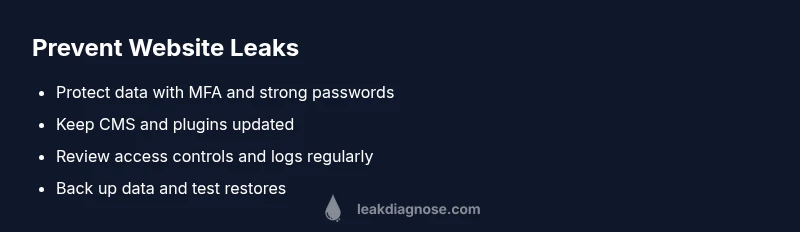
Prevention is easier than remediation. Enforce strong, unique passwords and enable multi-factor authentication everywhere possible. Keep all software patched, automate vulnerability scans, and limit access to sensitive areas with the principle of least privilege. Regularly back up data, test restorations, and keep an incident-response plan updated. Educate household users about phishing and social engineering to reduce human risk. Maintain a changelog of updates to help trace changes after a leak.
When to escalate to professionals
Some leaks require expert help. If sensitive data was exposed or you notice persistent unauthorized access, contact a cybersecurity professional or your hosting provider’s security team. Do not delay containment in hopes of a quick fix. A qualified specialist can perform deep forensics, validate backups, and help you implement long-term controls. For homeowners, keeping a documented timeline and evidence of changes will speed up the investigation and recovery.
Steps
Estimated time: 60-90 minutes
- 1
Secure access and audit users
Begin by locking down access: revoke unknown sessions, reset all admin passwords, and enable 2FA. Audit every user account for legitimacy and remove any unfamiliar roles.
Tip: Document every change to avoid reintroducing compromised accounts. - 2
Patch and verify software
Update your CMS core, plugins, and themes to the latest versions. Apply all security patches and restart services if required to ensure changes take effect.
Tip: Enable automatic updates where possible and test in a staging environment first. - 3
Review logs for anomalies
Download and inspect access logs, error logs, and firewall logs for unusual patterns, such as strange IPs, odd times, or file access anomalies.
Tip: Look for repeated patterns across multiple days to confirm persistence. - 4
Scan for malware and backdoors
Run trusted malware scanners and perform a code review of core files and custom scripts. Remove any suspicious code you find.
Tip: Back up before removing code to preserve a restore point. - 5
Contain and restore from clean backups
If you have backups, verify their integrity and restore from a known clean copy. Test the site in a controlled environment before going live.
Tip: Never restore from a backup you suspect is compromised. - 6
Reopen and monitor
Bring services back online gradually, monitor traffic and user activity, and set up alerts for new anomalies to catch regressions early.
Tip: Implement continuous monitoring to catch issues early.
Diagnosis: Website shows unusual admin activity or data exposure.
Possible Causes
- highCompromised admin credentials or password reuse
- highOutdated CMS/plugins/themes with known vulnerabilities
- mediumMalware/backdoor inserted via insecure access or FTP
- lowMisconfigured permissions or public exposure of sensitive files
Fixes
- easyImmediately revoke unknown access, rotate passwords, and enable 2FA; audit user list
- easyUpdate CMS/core/plugins/themes to latest versions; apply all security patches
- hardRun malware scanner, clean code, and restore from clean backups; verify integrity
- mediumHarden server config, restrict directory permissions, and review firewall rules
- easyReview and secure FTP/SFTP credentials; disable old keys; limit admin IP access
Questions & Answers
What is a website leak?
A website leak is unauthorized exposure of data through a website or service, often due to weak credentials, outdated software, or misconfigurations.
A website leak means data has been exposed online because of a security issue.
How can I tell if my site has been leaked?
Look for unusual login activity, new admin accounts, unexpected password resets, or unfamiliar data access patterns in logs.
Watch for strange logins, new admins, or unexpected data access.
Should I delete everything or restore from backup?
Restoring from a clean backup is recommended after containment; avoid restoring from compromised backups.
Restore only from a clean backup after confirming it's clean.
Do I need to hire a security expert?
If the leak involves sensitive data or persistent access, contact a cybersecurity professional or your hosting security team.
If access persists or sensitive data is involved, consider a professional.
Can I prevent website leaks?
Yes, implement strong authentication, regular updates, restricted access, and routine security scans.
Prevent leaks with good passwords, updates, and ongoing checks.
How long does it take to recover from a website leak?
Containment and remediation time varies, often from hours to days depending on scope.
Recovery time depends on how widespread the leak is, but quick containment helps.
Watch Video
Main Points
- Contain leaks quickly with credential hygiene.
- Patch software and verify backups before restoration.
- Monitor and restrict access to reduce future risk.
- Enable MFA everywhere and educate users on phishing.
- Document changes and review incident response regularly.