What Are the Symptoms of a Vacuum Leak? A DIY Troubleshooting Guide
Identify the signs of a vacuum leak, understand how it affects engine performance, and follow a safe, step-by-step troubleshooting flow to diagnose and repair.


Vacuum leaks usually show up as rough idle, stalling, or erratic engine performance. According to Leak Diagnosis, the most common causes are cracked hoses, loose fittings, or a faulty PCV valve. For a quick check, listen for a hiss, inspect intake hoses, and reseal or replace cracked parts. If symptoms persist, follow the diagnostic flow for a full fix. These leaks can also cause high idle and reduced fuel efficiency. Detecting and repairing them early saves fuel and prevents misfires. This quick answer helps you decide whether to dig deeper with a step-by-step diagnostic flow.
What is a vacuum leak and why it matters
A vacuum leak happens when unmetered air enters the engine’s intake, upsetting the air-fuel balance and forcing the ECU to compensate. Left unchecked, a leak can cause hesitation, reduced fuel economy, and more strain on the catalytic converter. According to Leak Diagnosis, even small leaks can create big performance issues, especially at idle or under acceleration. In everyday driving, these leaks are a common reason for rough idling and unusual engine sounds, so identifying them early helps you avoid costly repairs. In the sections that follow, you’ll learn how to recognize symptoms, perform safe checks, and decide when to seek professional help.
Common symptoms you can notice in everyday driving
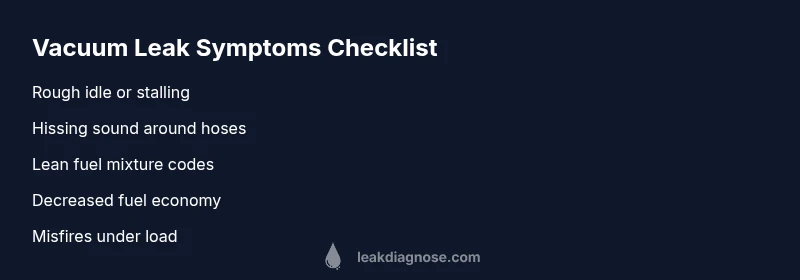
When you ask what are the symptoms of a vacuum leak, several telltale signs come up frequently. You may notice rough idle, stalling, or a sudden surge in engine speed that doesn’t match your pedal input. A vacuum leak can also cause high idle, poor acceleration, or decreased fuel efficiency. You might hear a faint hiss from hoses or the intake tract, especially under cold start or when the engine is under load. The Check Engine light may illuminate due to lean air-fuel mixtures. The Leak Diagnosis team emphasizes that these signs can overlap with other issues, so a careful, methodical approach is essential.
How vacuum leaks affect engine performance
A leak allows unmetered air to bypass the MAF or MAP sensor, causing the engine to run lean. Lean mixtures can reduce power, cause misfires, and raise exhaust temperatures. The ECU may compensate by increasing fuel, leading to reduced fuel economy and potential catalytic converter damage. In modern engines, vacuum leaks can trigger multiple fault codes and cause sensors to report abnormal readings. Understanding these effects helps you prioritize checks on the hoses, PCV system, and intake gaskets.
When to be concerned about vacuum leaks
Not every hiss means a leak; however, persistent symptoms warrant attention. If rough idle lasts more than a few minutes, if you notice stalling at stoplights, or if fuel economy drops noticeably, inspect for cracked hoses, loose fittings, or a faulty PCV valve. Also check gaskets around the intake manifold and throttle body. Early action reduces the risk of backfiring, check engine codes, and prevents potential damage to the catalytic converter.
How to differentiate vacuum leaks from other issues
Vacuum leaks share signs with other problems, so use a process of elimination. Compare the symptoms to known vacuum-leak patterns: audible hiss, lean fuel trims, and inconsistent idle. If the throttle responds normally but fuel trims are out of range, a leak is plausible. Use diagnostic tools: scan tool data, fuel trim readings, and spark plug condition. A smoke test can confirm leak locations without disassembly; this is a common method used by professionals.
Quick checks you can perform safely
Start with a visual inspection of all accessible hoses for cracks, splits, or loose clamps. With the engine off, gently wiggle hoses to feel for cracks; do not pull hard. For live engines, a safe trick is to spray soapy water around hose connections and look for bubbles indicating a leak. Check the PCV valve and its hose; replace if sticky or cracked. If you have a smoking extinguisher or smoke machine, a smoke test is highly effective but should be performed by someone trained.
What to do if symptoms persist
If the signs point to a vacuum leak but you cannot locate it, stop driving long distances and seek professional help. A mechanic can perform a smoke test, pressure test, or leak-down test to pinpoint the location. Replacing damaged hoses, securing loose clamps, and replacing PCV components usually resolves the issue. After repair, recheck with a drive cycle to confirm the issue is gone and monitor fuel economy.
Steps
Estimated time: 45-90 minutes
- 1
Inspect hoses and connections
With the engine off, visually inspect all accessible vacuum hoses for cracks, splits, or loose clamps. Gently twist and flex hoses to reveal hidden damage. Replace any damaged hoses and reseal clamps to restore a proper seal.
Tip: Check hose routing against a diagram to ensure you didn’t misroute a hose during previous work. - 2
Check the PCV system
Locate the PCV valve and its hoses; test for sticking or cracks. A faulty PCV valve can mimic a vacuum leak with similar idle symptoms. Replace the valve and hoses if you find wear or stiffness.
Tip: Always work with the engine cool and disconnect the negative battery terminal before replacing PCV components. - 3
Perform a smoke or soapy-water test
With the engine running (or after capping intake openings), spray a light layer of soapy water at hose junctions and watch for bubbles. Alternatively, use a smoke machine to reveal leaks without disassembly.
Tip: Keep a safe distance and avoid spraying near hot engine parts. - 4
Inspect intake manifold and gaskets
If hose checks fail to locate the leak, inspect the intake manifold gasket and throttle body seals for signs of wear or damage. A leak here often requires gasket replacement and torque-checked bolts.
Tip: Refer to your vehicle’s service manual for correct torque specs. - 5
Repair or replace damaged components
Replace cracked hoses, damaged clamps, or a faulty PCV valve. Ensure hose connections are tight and routed correctly to prevent future leaks.
Tip: Use OEM-grade clamps and match hose sizes precisely for a reliable seal. - 6
Test drive and verify
Start the engine and run through a few driving cycles, including idle, light throttle, and accel/decel. Recheck for symptoms and confirm that codes have cleared or stabilized.
Tip: If the Check Engine light returns, re-scan to pinpoint remaining issues.
Diagnosis: Car exhibits rough idle, stalling, or erratic engine behavior
Possible Causes
- highCracked or disconnected vacuum hoses in the intake system
- mediumFaulty PCV valve or PCV hose connection
- lowLeaking intake manifold gasket or throttle body gasket
Fixes
- easyInspect all visible vacuum hoses for cracks or disconnections; replace any damaged hoses and reseal joints
- easyTest and replace the PCV valve and associated hoses if sticky or cracked
- mediumIf leaks are in the intake manifold or gaskets, perform professional repair or gasket replacement
Questions & Answers
What are the most common signs of a vacuum leak in a car?
Rough idle, engine stalling, and poor acceleration are typical signs. You may also notice a hissing sound from hoses and a drop in fuel economy. A Check Engine Light may come on if the air-fuel mixture goes lean.
Common signs include rough idle, stalling, and reduced fuel economy. A hissing sound can indicate a leak.
Can a vacuum leak cause engine misfires?
Yes. A vacuum leak can lean out the air-fuel mixture, causing misfires or rough running, especially under load or at idle. Misfires may trigger fault codes related to ignition or emissions.
Yes, vacuum leaks can cause misfires, especially at idle or under load.
How can I locate a vacuum leak without expensive tools?
You can start with a visual inspection of hoses and the PCV system, then perform a soapy-water test at hose connections. A smoke test is more reliable but may require professional equipment.
Start with hose checks and a soapy-water test; a smoke test is more definitive but may need a pro.
Is driving with a vacuum leak dangerous?
Driving with a vacuum leak can worsen engine performance, trigger unexpected stalls, and damage emissions equipment over time. If you notice significant symptoms, limit driving and seek inspection.
It can be risky to drive with a vacuum leak; have it checked if you notice symptoms.
What should I do if I suspect a vacuum leak after a repair?
After a repair, perform a test drive and re-scan for codes. Check idle consistency and fuel economy, and look for fresh leaks or loose clamps.
After repair, test drive and re-scan to confirm the fix.
How long does it take to repair a vacuum leak?
Repair time depends on leak location and parts availability. Simple hose replacements can take under an hour; complex manifold gaskets may require more time.
Repair time varies; simple hose fixes are quick, gaskets may take longer.
Watch Video
Main Points
- Start with simple hose and PCV checks.
- Look for an audible hiss and lean-fuel codes as clues.
- A smoke test is the most reliable leak locator.
- Repair and re-test to confirm idle is stable and fuel economy returns.