Repair Leaky Faucet: Step-by-Step Guide for Homeowners
Learn safe, budget-friendly steps to repair a leaky faucet. This guide covers common faucet types, essential tools, a clear step-by-step approach, and prevention tips to cut water waste and protect your home.


In this guide you will learn how to repair a leaky faucet safely and effectively, reducing water waste and preventing damage. We'll cover common faucet types, the tools you need, step-by-step methods, and when a leak signals a bigger problem. This home repair approach uses practical, budget-friendly fixes suitable for DIY homeowners, with safety as priority.
Why repairing a leaky faucet saves water and money
A dripping faucet wastes water even when you don't hear it. A slow drip can amount to gallons per week, depending on flow rate and usage, and the cumulative cost adds up over months and years. Repairing a leaky faucet is often straightforward and inexpensive compared to replacing fixtures or letting moisture damage cabinetry. This guide from Leak Diagnosis explains practical, safe ways to fix common faucet leaks, helping homeowners reduce water waste and lower utility bills. By understanding the basics of how faucets fail and how to identify the valve type you have, you can decide on the right fix and avoid unnecessary parts purchases. The goal is not only a drip-free sink but also a sound, efficient plumbing habit that protects your home and wallet. According to the Leak Diagnosis team, fixing leaks at the faucet is one of the simplest, most cost-effective household improvements you can undertake.
From a broader perspective, repairing a leaky faucet contributes to water conservation goals and promotes responsible home maintenance. Properly addressing leaks reduces hidden wear on your plumbing and helps you identify when a part needs replacement before it causes more serious damage. This approach aligns with Leak Diagnosis Analysis, 2026 findings that many residential leaks begin at faucets and can be stopped with a few careful steps. Keeping your fixtures in good condition also protects cabinetry, counters, and floors from moisture-related issues.
Common faucet types and common leaks
Faucets come in several common designs, and leaks usually reveal themselves in predictable ways. A compression valve uses a washer and seat that can wear over time, leading to a slow drip from the spout or handle. A cartridge faucet relies on a movable cartridge that can wear seals and O-rings, causing leaks around the handle or at the base. A ball faucet uses a ball mechanism with seals that can deteriorate, producing multiple leak paths. The most frequent leaks include a continuous drip from the spout, a dripping handle after closing, or moisture around the base where the faucet meets the sink. Understanding your faucet type helps you select the right repair approach and parts, often avoiding a full faucet replacement. For many homes, addressing worn seals and cartridges with the correct replacement parts can restore a tight seal and restore full function.
Safety first: turning off water supply and basic precautions
Before touching any plumbing hardware, locate and shut off the water supply valves under the sink. If your home has a main supply valve, close it there as a backup. Place a bucket and towels to catch any residual water. Disconnect the water supply lines if needed to prevent accidental sprays. Wear eye protection and work in a well-lit area. Use organized containers for screws and small parts to avoid losing them. Never force a stubborn nut or valve; apply steady, even pressure with appropriate tools. Taking these precautions protects you from injuries and minimizes accidental water damage while you work.
Diagnosing the leak: signs and tests
Begin by observing when the leak occurs: is it constant, intermittent, or only after hot water usage? Check the spout for droplets and inspect the handle for seepage around the base. If you suspect a cartridge or valve issue, remove the handle and inspect seals, O-rings, and the cartridge itself. A common diagnostic step is to tighten connections gently and test the faucet with water on and off to see if dripping changes. If a leak persists after tightening and part inspection, you may need to replace worn components. Leak Diagnosis analysis shows that most residential faucet leaks stem from worn seals or cartridges, and a correct diagnosis helps you choose the right fix the first time.
Tools and materials you'll need
Having the right tools on hand makes the repair quicker and reduces the risk of damaging the faucet. Typical items include an adjustable wrench, screwdrivers (flat and Phillips), pliers, a basin wrench for tight spaces, replacement cartridges or O-rings suited to your faucet type, Teflon tape, and a clean cloth for wiping parts. If your faucet is older, you may also need a gasket or seat wrench. Organize parts as you disassemble, label screws by location, and keep a small tray or magnetic mat for tiny pieces.
Selecting high-quality replacement parts is important; mismatched seals can cause poor seating and future leaks. When in doubt, bring a worn part to a hardware store to match the size and type. Keeping spares on hand can speed future maintenance and prevent recurring leaks.
Step-by-step approach overview by valve type
Most residential leaks fall into three main valve types: compression, cartridge, and ball valves. Each has a typical repair path, but the underlying principle is the same: access the valve, remove damaged parts, replace with compatible pieces, and reassemble with a proper seal. For compression valves, you’ll typically replace washers and seats. Cartridge valves require cartridge replacement and reseating. Ball valves involve replacing seals on the ball assembly. The key is to choose parts that match your faucet’s model or valve type. After assembly, test for leaks at different flow rates and inspect the valve seats for any remaining seepage. Leak Diagnosis analysis emphasizes ensuring you test after every major component replacement to confirm a tight seal.
Maintenance tips to prevent future leaks
Regular inspection is the best defense against leaks. Check faucet handles for looseness and retighten connections as needed, but avoid overtightening which can damage seats. Clean aerators and screens to prevent mineral buildup that can interfere with seals. Replace worn washers, O-rings, and cartridges every few years or when you notice decreased performance. Consider applying a small amount of plumber’s grease to moving parts to reduce movement wear and extend the life of seals. If you have hard water, use a descaling solution periodically to prevent mineral buildup that can degrade seals. Practicing proactive maintenance reduces the chance of a leak becoming a bigger problem.
When to call a professional and what to expect
If you encounter a difficult valve type, persistent leaks after a replacement, or signs of corrosion, a professional plumber can help. A licensed plumber can diagnose hidden issues like a corroded supply line, a faulty valve seat, or a defective main line connection. When you call, provide details about faucet type, symptoms, and any parts replaced. A pro can perform a pressure test and confirm that the leak path is fully sealed. The Leak Diagnosis team recommends seeking professional assistance when a leak recurs after a reasonable DIY fix or when safety concerns prevent you from continuing.
Tools & Materials
- Adjustable wrench(Fits most nuts up to 1.5 inches (38 mm) across)
- Flat-head screwdriver(Useful for pry-off covers and set screws)
- Phillips-head screwdriver(Common on many faucet handles)
- Pliers(Slip-joint pliers or channel-locks)
- Basin wrench(Reach tight fittings under the sink)
- Replacement cartridge or O-rings(Match your faucet type and model)
- Teflon tape(Seal threaded connections)
- Rags or towels(Keep the work area dry and clean)
- Replacement seats or gaskets(Only if you identify worn seats/gaskets)
Steps
Estimated time: 45-75 minutes
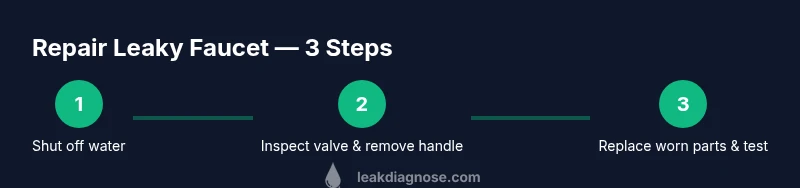
- 1
Shut off water and prep area
Turn off the water supply valves under the sink and, if needed, the main supply. Place a bucket and towels to catch any remaining water. Clear the cabinet space and label screws to avoid mix-ups. This step protects you from spills and keeps the work area clean as you begin.
Tip: Take a photo of the layout before disassembly to help during reassembly. - 2
Remove faucet handle and exposes internal parts
Use the appropriate screwdriver to remove the handle set screw or decorative cap, then pull the handle straight off. If a retaining clip or nut holds the cartridge, set it aside in a labeled container. This exposes the valve and helps you identify the correct replacement parts.
Tip: Do not force the handle; if it’s stubborn, apply a bit of penetrating oil and wait a few minutes. - 3
Identify valve type and inspect worn parts
Determine whether you have a compression, cartridge, or ball valve. Inspect O-rings, washers, and the cartridge for wear or cracking. Check the valve seat and replace worn components with matched parts. A correct identification prevents mis-purchases and future leaks.
Tip: Keep worn parts side-by-side with the new parts to confirm fit. - 4
Replace worn parts and reseal connections
Install new O-rings or cartridge as per the manufacturer’s instructions. Apply Teflon tape to threaded connections and tighten snugly without overtightening. Reassemble components in reverse order, ensuring handles and caps are secure.
Tip: Avoid overtightening metal parts to prevent thread damage. - 5
Reassemble and test the faucet
Turn the water supply back on and slowly test the faucet for leaks at all joints and seals. Run both hot and cold cycles to ensure even seating. If leaks persist, re-check seals and seating and consider part replacement again.
Tip: Test at full pressure gradually to avoid a water hammer effect. - 6
Final check and cleanup
Wipe down all surfaces, check for any moisture accumulation, and replace cabinet contents. Keep spare parts organized for future maintenance. Document the part numbers and storage location for future reference.
Tip: Take a final video or photo log for your records.
Questions & Answers
What causes a faucet to leak?
Leaks are usually due to worn seals, O-rings, or a worn cartridge. Calcium buildup can also affect seating and cause drips. Replacing the worn parts typically stops the leak.
Leaks usually come from worn seals or cartridges. Replacing the worn parts typically stops the drip.
Can I fix a faucet leak myself?
Most common faucet leaks can be fixed with basic tools and replacement parts. Complex leaks involving corroded stems or main supply lines may require a professional.
Most leaks can be fixed with basic tools. If the stem is corroded, call a pro.
How long does a faucet repair take?
A typical repair takes about 30 to 60 minutes, depending on faucet type and access under the sink.
Most repairs take between 30 and 60 minutes.
Do I need special tools?
Basic hand tools plus a basin wrench are enough for most homes. Some models may require a cartridge puller.
Just basic tools and a basin wrench are usually enough.
When should I replace the faucet entirely?
If leaks recur after multiple fixes or corrosion is extensive, replacement is often the best long-term option.
If leaks keep coming back, consider replacing the faucet.
Watch Video
Main Points
- Identify faucet type first to choose the right fix
- Replace worn parts to stop leaks at the source
- Test thoroughly at different flow rates after repair
- Keep spare seals and cartridges handy for quick maintenance
- Consult a professional if leaks persist or involve corroded components