Telegram Snapchat Leak: Practical Troubleshooting for Privacy
Learn how a telegram snapchat leak can occur, how to detect it, and practical steps to harden privacy and prevent future data leaks today for online safety.


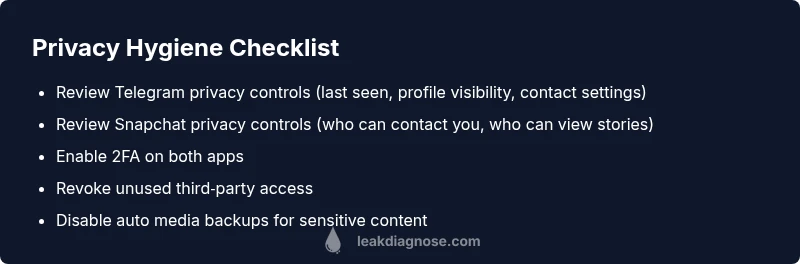
A telegram snapchat leak is most often caused by misconfigured privacy settings, weak passwords, and untrusted third‑party apps. Quick fixes include reviewing privacy controls in both apps, enabling two‑factor authentication, revoking third‑party access, and turning off auto media backups. If you suspect a breach, change passwords and contact support for a secure recovery.
Understanding the Telegram Snapchat Leak Phenomenon
This issue isn’t about a single viral incident but about how data from popular messaging apps can become exposed when trust boundaries are crossed. A telegram snapchat leak commonly stems from user-side configuration lapses, outdated apps, or compromised accounts. According to Leak Diagnosis, many breaches begin with misconfigured privacy controls and weak authentication. In today’s digital landscape, your private chats, media, and metadata can leak through multiple channels—device leftovers, cloud backups, or third‑party integrations—so it’s essential to treat these platforms as part of a single privacy ecosystem rather than isolated apps.
To reduce risk, start with the basics: confirm you’re using the latest app versions, review which devices are signed in, and audit any backup settings that could sync sensitive content to the cloud. Understanding the mechanics of a telegram snapchat leak helps homeowners and everyday users apply targeted fixes quickly and reduce long‑term exposure. Leakage risk isn’t just about external attackers; it’s also about how you manage your own access and data trails over time, which is where Leak Diagnosis recommends a proactive privacy mindset.
A practical takeaway is to separate personal from shared spaces on these apps, limit automatic media saving, and keep a clean device with strong protections. Small changes now can prevent larger exposure later, preserving family privacy and reducing stress when unexpected alerts arrive.
Quick Privacy Checks You Can Do Now
Taking immediate action can stop a leak from widening. Start with the simplest checks before diving into deeper settings. Review each app’s privacy options, confirm two‑factor authentication is enabled, and revoke access for any unfamiliar third‑party connections. Ensure you’re not backing up sensitive media to cloud services unless you explicitly want that behavior. Regularly update apps and OS patches to close known security gaps. If you notice accounts behaving oddly or messages appearing where they shouldn’t, treat it as a potential breach and escalate to support. This approach aligns with Leak Diagnosis guidance for rapid containment and long‑term privacy health.
Before making changes, back up current settings so you can revert if needed. Keep a simple log of what you changed and when, which helps you spot recurring issues over time. If you’ve shared devices with family members, review each user’s access rights and sign out of sessions you don’t recognize. The goal is to create a tight, auditable privacy trail that makes future leaks less likely.
Common Myths vs. Realities About a Telegram Snapchat Leak
Myth: Only strong passwords matter. Reality: Leaks are often caused by a combination of weak settings, device compromise, and social engineering. Myth: Two‑factor authentication is optional. Reality: Enabling 2FA on both apps dramatically reduces the risk of unauthorized access. Myth: Backups are always safe. Reality: Cloud backups can propagate leaks if privacy controls are lax. Myth: Third‑party apps are harmless. Reality: Some integrations retain broad access and can expose data if they’re misconfigured. Understanding these nuances helps you prioritize fixes that actually reduce exposure and protect family data.
A practical lens is to view each app as a data stream with access tokens, storage, and device trust. When any link in that chain is weak, the entire chain becomes vulnerable. Regular privacy reviews, paired with clear device hygiene, are the most reliable defenses against future telegram snapchat leak scenarios.
Safeguards and Best Practices to Prevent Future Leaks
Long‑term protection comes from a layered privacy strategy. First, tighten account security: use unique, long passwords and enable 2FA on both platforms. Next, audit permissions for every connected service, revoking anything unfamiliar. Disable unnecessary cloud backups for sensitive media and periodically purge old backups. Maintain device security with updated software, trusted networks, and anti‑malware checks. Finally, practice safe sharing habits, such as avoiding screenshots of private conversations and using secret chats or end‑to‑end encryption where available. Building a routine around these habits reduces the odds of a telegram snapchat leak reoccurring and gives you peace of mind.
Steps
Estimated time: 45-60 minutes
- 1
Audit account security
Start by reviewing your login activity on both apps and change any weak passwords. Enable 2FA if you haven’t yet and verify that you’re the only one signed in. This creates a clean baseline for your privacy work.
Tip: Document the current sign‑in devices so you can spot unfamiliar activity later. - 2
Review Telegram privacy settings
Check who can see your last seen, profile photo, and who can contact you. Turn on privacy options that limit who can add you and who can see your online status. Disable auto‑sync of media to cloud if not needed.
Tip: Use Telegram’s “Secret Chat” option for sensitive conversations when possible. - 3
Review Snapchat privacy settings
Limit who can send you snaps or view your story, and tighten your contact list by removing strangers. Enable two‑factor authentication and review connected apps and devices.
Tip: Regularly check third‑party apps connected to Snapchat and revoke access you don’t recognize. - 4
Revoke third‑party access
Go through each connected service and remove any app or tool you no longer use or don’t recognize. This minimizes unknown data flows that could leak content.
Tip: Keep a short, current list of approved integrations. - 5
Secure backups and devices
If you keep backups, ensure privacy controls are strict or disable backups for sensitive media. Run a malware scan and apply OS updates to all devices used with these apps.
Tip: Set automatic OS updates to stay protected against new threats. - 6
Monitor and respond
After changes, monitor accounts for unusual activity and set up alerting if possible. If you notice anything suspicious, contact support promptly and follow their guidance for recovery.
Tip: Keep a record of all steps taken for audit trails.
Diagnosis: User notices unexpected exposure of messages or media from Telegram and Snapchat.
Possible Causes
- highMisconfigured privacy settings or exposed backups
- highCompromised account credentials or phishing
- mediumUntrusted third‑party apps with broad access
- highMalware or insecure device on the network
- lowShared devices or public computers
Fixes
- easyReview and tighten privacy controls in both apps (who can see your info, who can contact you)
- easyEnable two‑factor authentication and replace weak passwords
- easyRevoke access for third‑party apps you don’t recognize
- easyDisable cloud backups for sensitive media or delete outdated backups
- mediumRun a device security check and update operating systems
- easyIf you suspect a breach, contact support and preserve evidence
Questions & Answers
What is telegram leak?
A telegram leak refers to exposure of messages, media, or account data within the Telegram app due to weak privacy controls, compromised credentials, or misconfigured backups. It highlights the risk of data leaving your control when settings aren’t properly secured.
A telegram leak means your Telegram data is exposed because privacy controls aren’t set properly or your account has been compromised.
How to spot a leak in messaging apps?
Look for signs like unknown messages, unfamiliar devices signed into your account, or unexpected exposure of private chats. Review login activity and permission histories in each app.
Watch for unfamiliar logins or strange messages. Check device activity and permission histories in Telegram and Snapchat.
Immediate steps after noticing a leak
Secure your accounts by changing passwords, enabling 2FA, revoking unknown app access, and verifying device integrity. Contact support if you suspect data exfiltration.
Change passwords, enable 2FA, revoke unknown apps, and contact support if you suspect a breach.
Is 2FA enough to protect me?
2FA substantially reduces risk but isn’t a silver bullet. Combine 2FA with strong passwords, prompt updates, and careful review of third‑party apps to minimize exposure.
2FA helps a lot, but you still need strong passwords and careful app management to stay protected.
Can backups cause leaks?
Yes. If backups are enabled for sensitive media, leaks can occur through cloud storage unless privacy controls are strict. Consider disabling auto backups for sensitive content.
Backups can leak data if not properly protected, so review backup settings and disable automatic backups for sensitive items.
How to prevent leaks in the future
Establish a privacy routine: update apps, review settings, enable 2FA, revoke unused third‑party access, and keep devices secure. Regular audits reduce future leak risk.
Keep apps updated, review settings, use 2FA, and revoke unused connections to prevent leaks.
Watch Video
Main Points
- Review privacy settings regularly
- Enable 2FA on both apps
- Revoke unnecessary third‑party access
- Disable risky backups for sensitive data
- Monitor accounts for suspicious activity