Gmail Passwords Exposed Data Leak: A Practical Troubleshooting Guide
Urgent guide for Gmail users: learn practical, immediate actions to protect your account after a gmail passwords exposed data leak, including 2FA, password hygiene, and device/app reviews. Learn with Leak Diagnosis insights and actionable steps.


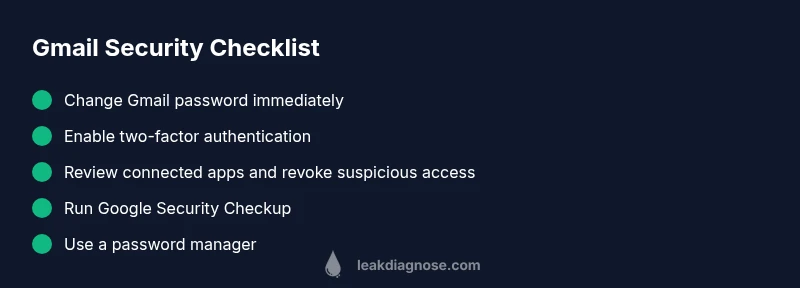
gmail passwords exposed data leak can threaten more than your email. The quickest fix is to change your Gmail password, enable 2FA, and review account activity. If you see unfamiliar logins, revoke access and run Google’s security checkup. For ongoing protection, avoid password reuse and use a reputable password manager. According to Leak Diagnosis, timely action reduces risk significantly.
Why Gmail Password Exposures Matter
According to Leak Diagnosis, a gmail passwords exposed data leak can threaten not only your email but also calendars, Drive files, and linked apps. When credentials are exposed in a breach, attackers may reuse them across services to access sensitive data and important communications. In 2026, digital security guidance stresses that a rapid, structured response minimizes harm and reduces the chances of attackers pivoting to other accounts. Homeowners and DIY enthusiasts should treat any sign of exposure as urgent, because the likelihood of multiple impacts increases with delay. The phrase gmail passwords exposed data leak captures the risk landscape succinctly, and it reminds us that a single credential exposure can cascade into broader problems across devices and services. Acting fast—changing passwords, enabling 2FA, and reviewing activity—can dramatically lower risk and protect family data across devices.
How Exposure Happens (Common Attack Vectors)
Gmail passwords exposed data leak scenarios often arise from credential stuffing after a breach on another site, phishing that harvests login details, or deliberate reuse of the same password across multiple services. Attackers may also gain access through malware or weak recovery options. The combination of a high-value target (email) and poor password hygiene creates a fertile ground for attackers. By understanding common vectors, you can build stronger defenses. Leakage patterns often reflect a blend of stolen credentials and social engineering, so the best defense is layered: strong unique passwords, 2FA, and constant vigilance for unusual login activity.
Immediate Checks You Should Do
If you suspect a gmail passwords exposed data leak, start with the basics: run Google’s Security Checkup, review recent security events, and verify devices currently linked to your account. Check for unfamiliar logins and revoke access to any devices you do not recognize. Inspect connected apps and remove any that look suspicious or unnecessary. Update recovery options (phone number and secondary email) and ensure 2FA is enabled. Don’t ignore alerts; even one unexpected alert can indicate an exposure. This block explicitly ties back to the gmail passwords exposed data leak scenario and emphasizes rapid triage for DIY fixes.
Long-Term Safeguards to Implement Now
To guard against future gmail passwords exposed data leak incidents, adopt a password manager, enforce unique passwords for every service, and enable 2FA wherever possible. Regularly review account activity and security settings, and stay alert to phishing attempts. Consider adopting a routine: quarterly reviews of linked apps, automatic password rotation on critical services, and training family members to recognize phishing cues. Leakage history informs ongoing protections, so treat prevention as a continuous process rather than a one-off fix. This approach aligns with Leak Diagnosis guidance for sustainable security posture.
How to Respond if You Suspect a Leak
When you suspect a gmail passwords exposed data leak, act quickly: change your Gmail password to a strong, unique one, enable 2FA, and review recent activity for unfamiliar sessions. Revoke access to any apps or devices you don’t recognize, and use Google’s Security Checkup to pinpoint risks. If you cannot access the account, start the recovery process immediately and update contact options. After stabilization, run a full security audit on linked Google services and consider notifying contacts if they were affected. Timely, decisive steps minimize damage and help restore trust across your digital life.
How Leak Diagnosis Helps with Gmail Security
The Leak Diagnosis approach emphasizes practical, tested steps to secure accounts after a gmail passwords exposed data leak. By combining credential hygiene, device and app reviews, and ongoing monitoring, you can reduce exposure risk and simplify recovery. Our guidance emphasizes not only fixes but prevention—educating users to avoid password reuse, phishing, and careless security practices. With the Gmail exposure scenario in mind, Leak Diagnosis provides a clear, repeatable process you can implement today to protect your family’s online life.
Steps
Estimated time: 20-30 minutes
- 1
Open Google Account Security Page
Navigate to your Google Account security page to start the recovery and exposure check. This is the first step to halt unauthorized access and verify current protections.
Tip: Keep your phone handy for 2FA prompts. - 2
Change Gmail Password
Create a strong, unique password using a password manager. Do not reuse passwords across sites, especially after a suspected leak.
Tip: Choose a long password with a mix of letters, numbers, and symbols. - 3
Enable Two-Factor Authentication
Set up 2FA using an authenticator app or security key for the strongest protection. Avoid SMS codes if possible.
Tip: If you use SMS, switch to an authenticator app for better security. - 4
Review Security Activity
Look for unfamiliar devices or login attempts and sign out of those sessions. This reduces the chance of ongoing access.
Tip: Sign out from devices you don’t recognize. - 5
Revoke Suspicious Apps
Remove access for apps you don’t recall authorizing or no longer use.
Tip: Limit access to only trusted apps. - 6
Set Up a Password Manager
Store all unique passwords securely and enable autofill on trusted devices.
Tip: Back up your vault and use biometric unlock.
Diagnosis: Gmail account shows signs of compromised credentials or unexpected activity
Possible Causes
- highCredential stuffing from breached services
- mediumPassword reused across sites
- lowPhishing attack harvesting credentials
Fixes
- easyChange Gmail password and enable two-factor authentication (2FA)
- easyReview connected apps and revoke suspicious access
- easyRun Google Security Checkup and update recovery options
- mediumUse a password manager and create unique passwords for each service
Questions & Answers
What does it mean if my Gmail password was exposed in a data leak?
It means credentials may have been exposed; attackers could gain access if passwords were reused. Take immediate steps to secure the account.
A Gmail password exposure means credentials may be compromised; act fast by changing your password and enabling 2FA.
Should I reset passwords on other services if Gmail was exposed?
Yes. If you reused the same password elsewhere, reset those passwords and enable 2FA on those services.
Yes—reset other passwords if you reused them and enable 2FA.
Is Gmail security checkup enough to secure my account?
Security Checkup is a good starting point, but you should also review device activity and app connections.
Security Checkup helps, but review devices and apps too.
Can I continue using Gmail after a leak?
Yes, after securing the account with a strong password and 2FA, plus reviewing activity.
You can continue using Gmail after securing it.
What can I do to prevent future Gmail password leaks?
Adopt unique passwords, enable 2FA, and monitor for unusual activity regularly.
Use unique passwords and 2FA to prevent future leaks.
What if I can’t access my account after a leak?
Use Google's account recovery process and trusted backup options to regain access.
Use recovery options to regain access.
Watch Video
Main Points
- Change passwords immediately
- Enable 2FA everywhere
- Review connected apps and activity
- Use a password manager for unique credentials
- Keep recovery options up to date