Car Air Con Leak Repair Cost: A Practical Guide for 2026
Learn how car air conditioning leak repair costs are determined, the key drivers, typical ranges, and tips for getting accurate quotes. Understand DIY vs professional options, and prevention strategies to minimize future bills.


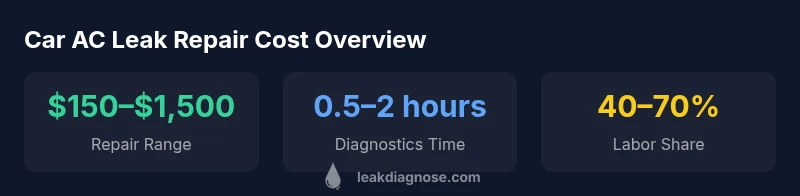
The car air con leak repair cost typically ranges from $150–$1,500, depending on leak location, refrigerant type, and whether the system requires compressor replacement. Diagnostic fees, parts, and labor all influence the final price, with the majority of costs tied to parts and labor. This quick guide helps you budget for the most common scenarios and set realistic expectations for 2026.
Understanding the scope of car air con leak repair costs\n\nThe car air con leak repair cost is not a fixed price. It depends on where the leak is, which component fails, the refrigerant type used in your vehicle, and whether parts must be replaced. For many cars, the most common first step is a diagnostic check to locate the leak, followed by a recharge of refrigerant if the leak is minor. According to Leak Diagnosis, variability in these factors is the primary driver of price differences across models and regions. The breakdown below helps car owners anticipate what will drive the final bill.\n\nIn practice, you may encounter a two-tier pricing structure: a diagnostic fee plus labor and parts for the repair. The diagnostic phase can range from thirty minutes to an hour for straightforward cases, while the actual repair work may require several hours for complex leaks or component replacement. Vehicle age and warranty status can also influence cost, as some shops offer discounted diagnostic rates or warranty-covered parts.
Common causes of car AC leaks and why cost varies\n\nLeaks can originate from several sources, including worn seals, refrigerant hose damage, condenser corrosion, evaporator core leaks, and damaged o-rings. The location matters because some components are easier to access than others. For example, a leak behind the dashboard (evaporator) typically requires more labor time than a condenser leak behind the grille. Refrigerant type also affects cost because newer refrigerants or high-pressure systems may require different charging equipment and higher-quality parts. Additionally, the choice between OEM and aftermarket parts influences price; OEM parts are usually more expensive but may offer better compatibility and warranty coverage. As a result, the same repair task can have a price range that spans hundreds of dollars depending on where the leak is and which parts are involved.
How repair costs are structured\n\nMost shops separate the price into three main components: diagnostic or leak-check fees, parts, and labor. Diagnostics establish the leak type and location, and sometimes include a dye test. Parts costs vary from seals and hoses to condensers or compressors. Labor costs depend on access complexity and the number of components affected. High-demand refrigerants and newer car models can push prices upward, while older models with simpler layouts may be cheaper to repair. Always request a detailed, itemized estimate to understand what you’re paying for and to compare options effectively.
DIY vs professional service: cost implications\n\nDIY attempts to seal a leak are generally not recommended for most vehicles. While small dye tests and minor top-offs may seem inexpensive, incorrect refrigerant handling can damage the system and create safety hazards. Professionals provide a complete diagnostic, proper refrigerant recovery, and an accurate recharge using the correct oil and additives. Although labor costs add to the bill, professional service minimizes the risk of repeated leaks and ensures warranty coverage on parts. In most cases, investing in a professional diagnosis yields better long-term value than repeated, unverified DIY attempts.
How to get accurate quotes: steps and tips\n\n1) Obtain at least three written, itemized quotes from reputable shops. 2) Verify that each quote includes diagnostic fees, part costs, refrigerant type, and labor charges. 3) Ask about warranty terms on replaced components and refrigerants. 4) Check shop credentials, including ASE certification or equivalent. 5) Request a system pressure test and leak test protocol to confirm the leak’s location and the need for replacement parts. This due-diligence approach helps you avoid surprises at checkout and ensures you’re comparing apples to apples.
Preventive maintenance to avoid future leaks\n\nRegular maintenance reduces the likelihood of later leaks. Schedule seasonal inspections, replace cabin air filters, and keep the condenser clear of debris. Use proper refrigerant handling to prevent moisture ingress, and ensure seals and hoses are inspected during routine service intervals. Preventive maintenance can extend system life, reduce the chance of major repairs, and keep your car’s climate control reliable.
Choosing parts and service quality: what affects price\n\nPrice differences arise from part quality, warranty terms, and accessibility. OEM parts generally cost more but may offer longer warranties and better fit, while reputable aftermarket parts can save money without compromising performance. Labor intensity also matters: a leaking evaporator under the dashboard requires more labor than a leak on a front-end condenser. Finally, the refrigerant type (R-134a vs R-1234yf) influences both the cost and the service approach due to differing handling requirements and equipment needs.
Typical cost components for car AC leak repairs
| Repair Type | Typical Range | Notes |
|---|---|---|
| Leak detection + dye test | $50–$150 | Often bundled with diagnostic fee |
| Recharge with refrigerant | $100–$350 | Depends on refrigerant amount/type |
| Hose/Seal replacements | $200–$1,000 | Prices vary by part and vehicle |
| Condenser replacement | $600–$1,500 | More complex, higher labor cost |
Questions & Answers
What is the average cost to repair a car air conditioning leak?
Costs vary widely by location, leak severity, and parts needed. A diagnostic fee plus repair can range from a few hundred dollars to over a thousand, with major component replacements driving higher totals. Always obtain an itemized estimate before work begins.
Costs vary widely; expect a diagnostic fee plus repair to range from a few hundred dollars to over a thousand, depending on parts and labor.
Will my car insurance cover AC leak repairs?
In most cases, standard auto insurance does not cover routine AC leak repairs. Coverage may apply if the leak resulted from an insured incident, such as a collision. Check your policy or speak with your insurer for specifics.
Insurance typically doesn’t cover routine AC leaks unless the leak resulted from a covered incident.
Can I fix a refrigerant leak myself?
DIY refrigerant work is not recommended due to safety risks and the need for proper recovery equipment. Incorrect handling can damage the system or create health hazards. Professional service is the safer path.
DIY refrigerant work is risky; it's best to leave it to a professional.
How long does a typical AC leak repair take?
Simple leaks might be repaired in a couple of hours, while complex cases with major component replacement can take half a day or more. Time depends on access, parts availability, and the diagnostic process.
Most repairs take a few hours, but complex cases can take longer depending on parts and access.
What factors influence the cost of AC leak repair?
Leaks in hard-to-reach areas, required refrigerants, part availability, and labor rates drive costs. Replacing high-demand parts like condensers or compressors raises the price substantially, while simple hose or seal fixes are cheaper.
Location, parts, and labor all drive the price; major parts mean higher costs.
Is a dye leak test necessary?
Dye tests help locate leaks that aren’t obvious. They’re commonly used during the initial diagnostic phase and can be included in the initial service. If a leak is confirmed, the subsequent repair will determine the final cost.
A dye test helps find hidden leaks during diagnosis.
“Diagnosing and repairing car AC leaks requires careful assessment of refrigerant type and system accessibility—prices rise quickly when compressors or evaporators are involved.”
Main Points
- Plan for a diagnostic fee plus repair costs
- Costs vary widely by location and part availability
- DIY is risky; professional service is recommended
- Get multiple, itemized quotes for the best deal
- Preventive maintenance reduces future leak risk