Car AC Leak Repair Cost: A Practical Guide
Understand the full scope of ac car leak repair cost, what drives prices, and how to get accurate quotes. Learn typical ranges for refrigerant recharge, component repairs, and labor, plus money-saving strategies.


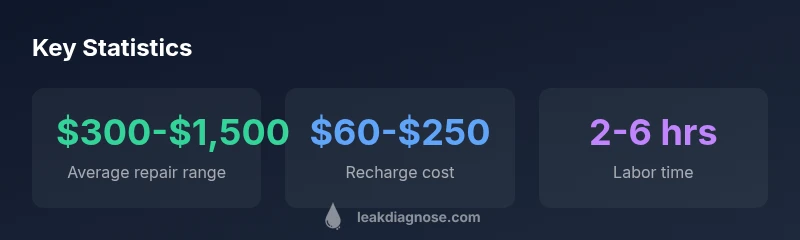
The ac car leak repair cost usually falls in a broad range: most common refrigerant leaks and hose fixes run about $250-$1,000, while evaporator or condenser leaks can push total bills toward $1,000-$2,000. Labor is typically 1-4 hours at $80-$150 per hour, depending on vehicle and diagnostic needs and complexity.
Understanding the ac car leak cost
Car air-conditioning systems are sealed networks that rely on refrigerant, seals, hoses, and a few critical components like condensers and evaporators. When a leak occurs, the cost is not just the price of refrigerant. It includes diagnostic time, locating the leak, potential dye tests, part replacement, and labor. In our experience at Leak Diagnosis, the broadest factor is the location and accessibility of the leak. Minor leaks that only require a refrigerant recharge and dye inspection tend to stay on the lower end of the spectrum, while leaks inside the evaporator or condenser often require disassembly, increasing both parts and labor costs. For budgeting purposes, plan for the possibility that a repair could exceed a simple recharge if the leak is harder to access or requires a major component replacement.
Factors influencing AC leak repair costs
Prices are influenced by several variables: the location of the leak (external hoses vs. internal coil), the refrigerant type (R-134a vs. newer options such as R-1234yf), vehicle make and model, and regional labor rates. Diagnostic fees vary and may be waived if you proceed with the repair. The cost of parts can vary widely depending on OEM versus aftermarket options, warranty coverage, and the need for additional components like accumulator/dryer replacements or new seals. In addition, some vehicles require labor-intensive evaporator or condenser work, which sharply raises the bill. As a rule, a precise diagnosis helps prevent unnecessary replacements and saves money in the long run.
Common leak locations and their cost implications
The most common leak sites include refrigerant hoses and connections, the condenser, the evaporator coil (often tucked behind the dashboard), and the compressor seals. Hoses and connections are usually the least expensive to fix, but an evaporator leak means interior dashboard work and can become a major expense. Condenser leaks vary by vehicle design and mounting; in some cars, a front-end radiator removal is required to access a leak, increasing both parts and labor costs. Compressor-related leaks are among the most expensive repairs, sometimes requiring full compressor replacement.
Cost-saving strategies and getting accurate quotes
To avoid surprises, obtain itemized quotes from multiple shops. Ask for a written estimate that separates diagnostic fees, parts, and labor. If a dye test is suggested, verify whether it’s included in the diagnostic phase or billed as a separate service. Some shops offer free diagnostics if you proceed with the repair; others charge up front. When possible, request estimates for both a refrigerant recharge alone and a full leak repair to compare long-term value. Keep in mind that cheaper upfront options might lead to recurring costs if the leak recurs.
DIY vs professional repair: when to DIY
Diy attempts on an AC refrigerant leak are not advised due to refrigerant handling requirements and potential hazards. Small dye tests and simple hose-tightening tasks are sometimes manageable, but the risk of under- or over-charging refrigerant is high. A professional service ensures proper recovery, leak testing, and correct refrigerant recharge. If you suspect a leak, prioritize a diagnostic visit to confirm the location and scope before attempting any home-based fixes.
Regional and vehicle-type variations to expect
Labor rates vary by region, with higher costs typically found in urban areas. Vehicle complexity matters: modern compact cars may be quicker to service than larger SUVs, but high-end luxury models with specialized components can incur bigger parts costs. The refrigerant type used in your vehicle and local regulations around refrigerants may also influence price, especially with newer car models that require environmentally friendlier gases.
Maintenance tips to minimize future leaks
Regular maintenance reduces the chance of leaks. Schedule periodic inspections of hoses, seals, and connections; replace aging components proactively; and consider a dye test during routine service to catch slow leaks early. Keeping the system clean and charged at the recommended level minimizes stress on the compressor and other critical parts. Finally, addressing small leaks promptly can prevent more expensive failures later.
What to ask your shop to avoid upsells
Ask for an itemized, written quote that includes diagnostic charges, parts, and labor. Request the exact leak location and required parts before authorizing replacement. Inquire whether the refrigerant recharge is included in the estimate or billed separately. Ask about warranty terms for the repaired components and whether any core charges apply. Clear questions help you avoid unnecessary replacements and ensure you’re paying for what you truly need.
Typical cost ranges by repair type for car AC leaks
| Component | Estimated Cost Range | Notes |
|---|---|---|
| Refrigerant recharge | $60-$250 | Assumes no major leak detected |
| Hose or fittings | $150-$500 | Low-pressure lines; dye test may be needed |
| Condenser replacement | $400-$1,200 | Depends on accessibility and labor |
| Evaporator replacement | $600-$1,400 | Most extensive interior repair |
| Compressor replacement | $800-$1,700 | Highest cost; may include recharge |
Questions & Answers
What is the typical ac car leak repair cost?
Costs vary widely by location and leak type. A refrigerant recharge with minor leak fixes can be relatively affordable, while evaporator or condenser leaks drive up the price. Always seek an itemized quote after diagnosis.
Refrigerant recharge with minor repairs is usually cheaper than interior coil repairs, which can be more expensive after diagnosis.
What affects the cost of repairing an AC leak?
Leak location, refrigerant type, vehicle model, labor rates, and diagnostic charges all influence cost. Accessibility and whether a full component replacement is needed are critical cost drivers.
Location and accessibility are the big cost drivers, along with the type of refrigerant and the need for parts replacement.
Is it cheaper to repair or replace the entire AC system?
For small leaks, a repair plus recharge may be cost-effective. If leaks are widespread or multiple components fail, replacement or system overhaul could be more economical in the long run.
Often repairing the specific leak is cheaper, but widespread issues may justify a full system approach.
Can I fix a refrigerant leak myself?
Releasing or recharging refrigerant requires specialized equipment and regulatory compliance. DIY attempts can be dangerous and are not recommended; seek professional service for leaks.
Recharging refrigerant yourself is risky and usually not allowed; get a trained technician to handle leaks.
How long does an AC leak repair take?
Diagnostics can take 30 minutes to a few hours, while actual leak repair duration depends on location and parts. Expect a same-day service for simpler fixes and longer for complex evaporator replacements.
It varies, but many repairs can be done in a day if the leak is straightforward.
Will a leak reappear after repair?
If the root cause is properly addressed and components are replaced as needed, the risk of recurrence decreases. Ongoing maintenance helps catch issues early.
If the fix is done correctly and leaks are properly tested, recurrence should be low.
“Accurate leak detection is the cornerstone of a cost-effective repair; a precise diagnosis helps avoid unnecessary parts and repeated trips for the same issue.”
Main Points
- Define the leak location first to prevent wasteful repairs
- Expect broad cost ranges tied to access and parts
- Get itemized quotes from multiple shops
- Prioritize professional diagnosis over DIY attempts
- Maintenance reduces future leak risk