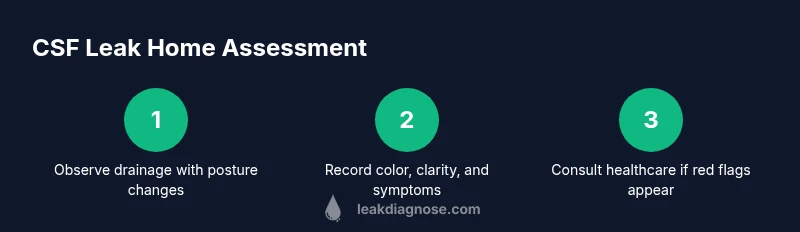
How to Test for CSF Leak at Home
Learn how to safely screen for a potential CSF leak at home with clear observations, safety notes, and when to seek medical confirmation. This guide helps you triage symptoms and plan professional testing.


Learn to identify a suspected CSF leak at home using safe, noninvasive checks: observe nasal drainage after bending or coughing, note fluid characteristics (clear, watery with a salty taste), and monitor for positional headaches. This guide provides a step-by-step home assessment, practical safety notes, and clear thresholds for seeking urgent medical evaluation.
Understanding CSF leaks and why home checks have limits
A cerebrospinal fluid (CSF) leak occurs when the protective fluid surrounding the brain and spinal cord escapes through a tear or hole, often after head injury, surgery, or spinal procedures. Signs can be subtle and mistaken for allergies or viral illnesses. According to Leak Diagnosis, CSF leaks are medical concerns that require careful evaluation, and home observations should be used as early warning signs rather than a definitive diagnosis. This section lays the groundwork: how CSF leaks arise, what makes them risky (risk of meningitis if untreated), and why professional testing is essential to confirm the presence and source of CSF in nasal discharge. By understanding the anatomy and typical scenarios, you’ll know what patterns in symptoms deserve closer attention and timely medical advice.
Recognizing signs and fluid characteristics you might observe at home
CSF leaks most commonly present as persistent, clear nasal drainage that may occur after posture changes, coughing, sneezing, or bending forward. The fluid is often described as watery and colorless, and some people report a salty or metallic taste. Headache patterns can differ, with postural headaches that worsen when upright and improve when lying down. Other clues include simultaneous neck stiffness, photophobia (sensitivity to light), or a fluid smell different from ordinary mucus. While these observations can raise suspicion, they are not a substitute for medical testing. Leak Diagnosis analysis notes that confirming a CSF leak requires lab analysis and imaging to locate the leak site and assess its cause. If nasal drainage persists or you notice a consistent pattern across several days, plan a clinical evaluation promptly.
What you can and cannot confirm at home
Home observations can raise awareness but cannot confirm a CSF leak. A definite diagnosis typically involves lab testing of the suspected fluid (e.g., beta-2 transferrin testing) and imaging studies to pinpoint the leak. Do not rely on home tests to rule out serious conditions; persistent clear drainage, especially after head trauma, head surgery, fever, stiff neck, or rapidly worsening headaches, warrants urgent medical attention. The goal of home checks is to educate you about symptoms, document patterns, and prepare you for a clinician visit. If you’re uncertain, err on the side of caution and seek professional care. The Leak Diagnosis team emphasizes that professional evaluation is the gold standard for CSF leaks.
Safe home observation protocol
Use a calm, well-lit environment to observe drainage patterns over several hours, especially after posture changes. Avoid attempting to collect or sample the nasal fluid; fluids from the nose can come from several sources, and only a lab test can determine if CSF is present. Keep a simple symptom log: time of drainage, posture, headache intensity, and any accompanying symptoms such as fever or neck stiffness. If you notice a persistent nasal clear discharge that correlates with posture, contact a healthcare provider for guidance and arrange appropriate testing. Do not delay medical care for fear of overreacting; early evaluation improves outcomes in many cases.
Home-to-clinic triage: when to seek urgent care
Urgent care is warranted if you experience a combination of clear nasal drainage plus fever, neck stiffness, confusion, new onset severe headache after head injury, or rapid neurological changes. Red flags include persistent vomiting, vision changes, new weakness, or extreme lethargy. If you recently had head trauma or spinal surgery and now have clear drainage, treat this as a potential emergency until proven otherwise. The presence of fever with drainage may indicate infection that requires immediate evaluation. In these situations, seek prompt medical attention or go to the nearest emergency department.
What to document before your clinician visit
Create a concise log that includes: (1) onset and duration of drainage, (2) posture-related changes (e.g., drainage increases when upright), (3) color, clarity, and any taste notes, (4) associated symptoms (headache location, neck stiffness, fever), and (5) any recent head injury or surgery. Photographic photos of the fluid on a tissue can help clinicians later, but do not rely on visuals alone for diagnosis. This documentation supports rapid, accurate testing and reduces delays in care. Leak Diagnosis’s guidance emphasizes keeping your notes organized to facilitate a smooth medical evaluation.
Next steps and professional testing options
If CSF leakage is suspected after home observation, your clinician may recommend tests such as beta-2 transferrin analysis of the nasal fluid, MRI or CT cisternography to locate the leak, and possibly a CT scan to assess skull base integrity. Treatments vary by cause and location and can include conservative management, antibiotics if infection risk is present, or surgical repair in some cases. While home checks are valuable for early awareness, definitive confirmation and treatment require professional testing and diagnosis. The Leak Diagnosis team recommends arranging timely medical evaluation when red flags appear or when symptoms persist beyond a few days.
Tools & Materials
- Notebook and pen(To record timing, symptoms, posture changes, and observations)
- Clean tissues or cloths(For capturing any drainage on tissues safely)
- Mirror(Helpful to observe drainage from different angles)
- Timer or watch(To track duration and postural change intervals)
- Calendar or app for logs(Optional for long-term symptom tracking)
Steps
Estimated time: 60-90 minutes
- 1
Gather materials
Collect your logging tools, tissues, and a timer. Set aside 15 minutes to observe patterns and note them clearly. Why: a prepared space reduces interruptions and helps you capture consistent observations.
Tip: Put the timer in reach and start a fresh page in your notebook. - 2
Observe drainage after posture changes
Bend forward or sit up, then observe any nasal drainage for 5–10 minutes. Note clarity, color, and whether drainage increases with upright posture. Why: postural changes can influence fluid flow and help distinguish CSF-related drainage from mucus.
Tip: Record at multiple intervals (e.g., every 2–3 minutes) to spot a pattern. - 3
Check for associated headaches
Track headache characteristics over the next hour: location, intensity, and whether the pain worsens when upright. Why: positional headaches are commonly reported with CSF leaks, though they are not diagnostic alone.
Tip: Use a simple 0–10 scale to quantify pain and note any relief when lying down. - 4
Avoid collecting fluid samples
Do not attempt to sample or collect nasal fluid for at-home testing. Why: CSF testing requires specialized lab analysis and improper collection can cause harm or misinterpretation.
Tip: If you have any fluid, photograph it on tissue but do not swab or extract. - 5
Document red-flag symptoms
Record fever, neck stiffness, confusion, or rapid neurological changes. Why: these symptoms can indicate meningitis or other serious conditions requiring urgent care.
Tip: Set a reminder to contact a clinician if any red flags appear. - 6
Plan medical follow-up
If drainage persists or symptoms continue beyond a few days, schedule an appointment for formal testing and imaging. Why: definitive diagnosis guides treatment options and reduces risk of complications.
Tip: Bring your symptom log to the appointment to streamline evaluation.
Questions & Answers
Can I diagnose a CSF leak at home?
No. Home observations can raise suspicion, but a CSF leak must be confirmed with lab testing and imaging performed by a clinician.
Home checks can raise suspicion, but a CSF leak requires professional testing for confirmation.
What red flags require urgent care?
Fever with drainage, neck stiffness, severe or sudden headaches, confusion, or neurological changes require urgent medical evaluation.
Urgent care is needed if you have fever with drainage, neck stiffness, or any new neurological symptoms.
What tests do doctors use to confirm a CSF leak?
Doctors use beta-2 transferrin testing on the nasal fluid and imaging such as MRI or CT cisternography to locate the leak source.
Clinicians typically use beta-2 transferrin testing and MRI or CT cisternography.
Is beta-2 transferrin testing available outside hospitals?
This test is usually performed in clinical laboratories or hospital settings and is not a home test.
Beta-2 transferrin testing is done in labs, not at home.
What should I bring to my medical visit?
Bring your symptom log, any photos of drainage on tissue, and notes about trigger events, posture changes, and associated symptoms.
Bring your symptom log and any drainage photos to the appointment.
Main Points
- Observe but do not sample nasal drainage.
- Posture-related changes and headaches warrant clinical evaluation.
- Definitive CSF leak diagnosis requires imaging and lab tests.
- Document findings thoroughly to accelerate medical testing.
- Seek urgent care if fever, neck stiffness, or confusion occurs.