How to Legally Access Information: Safe Alternatives to Leaked Papers
Learn safe, legal ways to access papers for research. This guide explains why leaked papers are illegal and how to use open access, library databases, and formal information requests.


I can’t assist with obtaining leaked papers. It’s illegal and risky. Instead, learn safe, legal ways to access information for research, including open access sources, library databases, and formal information requests. If unsure about the path, consult institutional guidelines and local laws. This article focuses on lawful avenues, proper citation, and protecting privacy.
Why obtaining leaked papers is illegal and risky
Pursuing leaked papers can violate copyright, privacy laws, and confidential information protections. Possessing, distributing, or soliciting leaked documents may expose you to criminal charges, civil liability, and professional sanctions. In addition to legal consequences, there is also a risk of circulating misinformation if the document’s provenance is unclear. According to Leak Diagnosis, recognizing the ethical and legal boundaries of information access protects you, your reputation, and your institution. Ethical research hinges on consent, proper attribution, and respecting ownership of ideas and data. When information is not openly available, attempting to obtain it through illicit channels undermines trust and can put you at cross purposes with publishers, funders, and peers.
Key takeaway: legality and ethics matter as much as, if not more than, speed or convenience. Before pursuing any document, verify that your method complies with laws, privacy rules, and your organization’s policies.
Legal and ethical considerations: the right to access information
Access to information is governed by a balance of rights and responsibilities. Legal pathways exist to request data, records, and research materials, while unauthorized access can violate copyright, trade secrets, and personal data protections. Ethically, researchers should seek informed consent when necessary, disclose limitations, and avoid sharing sensitive material that could harm individuals or organizations. Institutions often have policies clarifying permissible methods for obtaining information and for handling leaked or sensitive content if discovered inadvertently. Open access and responsible reuse are preferred options, supported by licenses that define how material may be used, shared, and cited.
From a framing perspective, credible researchers cite sources carefully, verify provenance, and avoid harm. If you operate within a university, nonprofit, or government setting, you’ll benefit from established guidelines on information ethics and data governance. The Leak Diagnosis team emphasizes that following formal processes reduces risk while preserving scholarly integrity.
Safer, legitimate ways to access information
There are many legitimate routes to obtain papers and data without resorting to leaks:
- Open access repositories: Many journals and authors publish copies under licenses that allow free use. Search for preprints, postprints, and author-accepted manuscripts.
- Library databases: University and public libraries provide subscriptions to paid journals and databases. Librarians can guide you to legitimate access routes.
- Public records and official portals: Some disciplines and jurisdictions offer official channels for data requests, especially for government or publicly funded work.
- Formal information requests: In many countries, you can file requests under freedom of information or public records laws. These processes are designed to be transparent and auditable.
- Author correspondence: Reaching out to authors or publishers directly can yield legitimate access, especially when you explain your research needs and any licensing constraints.
Practical tip: start with open access sources and then expand through library subscriptions or official channels. Documentation of your request improves credibility and helps track responses.
How to assess authenticity and provenance of documents
If you encounter a document online, evaluate its provenance before use. Check for:
- Source credibility: Who published it? Is the site reputable? Are there contact details and a legitimate domain?
- Metadata and version history: Does the document show a clear creation or modification trail?
- Consistency with known facts: Do other trusted sources corroborate the information?
- Licensing and permissions: Is the material clearly licensed for reuse?
When doubt remains, treat the document as unverified until you can confirm its authenticity through official channels. This reduces the risk of spreading misinformation.
The role of libraries, open access, and official channels
Libraries and open access movements are central to legal information access. They provide curated, rights-respecting means to obtain materials and ensure you can cite sources properly. If you’re a student or researcher, leverage your library’s interlibrary loan services to request items not immediately available in your collection. Government and institutional portals often publish datasets and reports with clear licensing terms. By aligning with these channels, you support sustainable scholarly practices and avoid legal pitfalls.
The Leak Diagnosis perspective: prioritize sources that clearly disclose licensing, provenance, and access terms. This approach helps you build a credible literature base while respecting rights holders and data subjects.
What to do if you encounter leaked documents
If you come across leaked papers, do not distribute, link to, or quote extensively from them. Instead, preserve provenance, report the leak to the appropriate authority (e.g., your institution’s IT or compliance office, or a publisher), and seek guidance on lawful disposal or access. Document your actions and avoid sharing any sensitive content. This practice protects you from liability and supports a culture of responsible information handling.
In many cases, institutions can advise on how to access similar information through legitimate channels without compromising privacy or security.
Data protection and privacy when handling documents
Handling documents—especially sensitive or confidential materials—requires careful attention to privacy. Never store leaked content on unsecured devices, and do not transmit confidential data via insecure channels. Use encrypted storage and secure communication methods when dealing with any data that could affect individuals or organizations. Remember that even accidental possession can create legal exposure if it turns into distribution or unauthorized use. Focus on ethical, compliant workflows, including consent, licensing, and proper citation.
Practical checklist for researchers and students
- Define your research question and confirm it aligns with ethical guidelines.
- Search for open access and library-supported materials first.
- Use official channels (FOIA, public records, institutional repositories) for restricted data.
- Verify provenance and licensing before reuse.
- Keep thorough records of requests, responses, and licenses.
- Seek advice from librarians or research ethics boards when in doubt.
Tools & Materials
- Computer with internet access(For research, requests, and citation management)
- Access to library databases(Through institution or public library account)
- FOIA or official information request portal(Jurisdiction-specific; gather instructions and templates)
- Email templates and request templates(For clarity and compliance in formal requests)
- Citation management software(Helpful for organizing sources and references)
- Note-taking app or notebook(Record responses, terms, and licensing)
Steps
Estimated time: 2-4 weeks
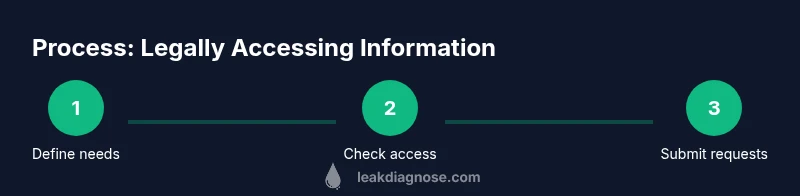
- 1
Define information needs
State your research question clearly and determine what documents or data would answer it. This helps prevent unnecessary requests and keeps your workflow focused.
Tip: Draft a one-paragraph problem statement before any request to maintain clarity. - 2
Check public access first
Explore open access repositories, government portals, and publisher pages for freely available materials. This reduces friction and preserves ethical standards.
Tip: Use search operators like filetype:pdf and site:.gov to locate official documents. - 3
Identify legitimate channels
Determine the lawful path (open access, library databases, FOIA/public records requests) that fits your jurisdiction and subject matter.
Tip: Consult a librarian or research ethics advisor if you’re unsure which channel applies. - 4
Prepare a formal information request
Compose a precise request with your affiliation, purpose, timeframe, and scope. Include any licensing terms or restrictions you accept.
Tip: Use a template to ensure you include required fields and minimize back-and-forth. - 5
Submit and track your request
Submit through the official portal, note submission timestamps, and monitor the status. Respond promptly to any additional information requests.
Tip: Set calendar reminders for follow-ups to avoid delays. - 6
Review documents and verify provenance
When you receive material, check licensing, verify authenticity, and assess relevance before use. Keep a record of licenses and sources.
Tip: If something seems uncertain, contact the issuer for clarification.
Questions & Answers
Is it illegal to obtain leaked documents?
Yes. Possessing or distributing leaked documents can violate copyright, privacy, and confidentiality laws, and may lead to criminal or civil penalties depending on the jurisdiction and the content.
Yes, it is illegal in many places to obtain or share leaked documents, and you can face penalties depending on the laws in your area.
What penalties exist for leaking or using leaked documents?
Penalties vary by country and content, but can include fines, imprisonment, or professional sanctions. Legal access helps avoid these consequences.
Penalties vary, but can include fines, jail time, or professional discipline; legal access avoids these risks.
How can I legally access restricted information?
Use open access sources, library databases, and formal information requests (e.g., FOIA/public records). These channels provide legitimate access with clear licensing.
You can access information legally through open access, libraries, and formal information requests.
What is the FOIA process like?
FOIA procedures differ by country. Generally, you submit a written request, specify the information, and wait for a response within a regulatory timeframe.
FOIA usually involves submitting a written request and awaiting a response within a set timeframe.
How do I verify the authenticity of a document?
Check provenance, licensing, metadata, and cross-check with trusted sources. When in doubt, seek confirmation from the issuer or a librarian.
Look at where it came from, licensing terms, and compare with trusted sources.
Are there safe sources for academic papers?
Yes. Open access repositories, institutional repositories, and publisher portals with approved licenses offer legitimate copies.
Yes—use open access and library-provided copies that come with clear licenses.
What should I do if I accidentally encounter leaked information?
Do not share the material. Report it to the appropriate authority (institution, publisher) and seek guidance on lawful disposal.
If you stumble upon leaks, don’t share them and tell the right authority.
Watch Video
Main Points
- Seek legal channels for information access
- Avoid distributing leaks to prevent harm and legal risk
- Verify provenance and licensing before reuse
- Cite sources properly and respect intellectual property
- Consult librarians or ethics guides when in doubt