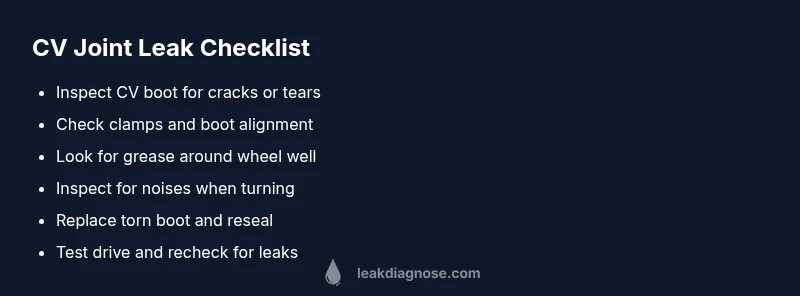
CV Joint Leak Troubleshooting Guide
Learn to quickly identify, diagnose, and fix a cv joint leak. This guide covers torn boots, seals, diagnostics, safety tips, and when to call a pro for automotive leaks.


The most common cv joint leak starts at a torn CV boot or a damaged axle seal. Begin by locating grease seepage around the outer CV boot and axle. If the boot is cracked, replace it and re-grease the joint. If you notice metal shavings or wobble, the CV joint may be damaged and the axle may need replacement.
What Causes a cv joint leak
A cv joint leak almost always traces back to a torn CV boot that allows grease to escape and dirt to enter the joint. The boot’s job is to keep lubricant in and contaminants out; when it splits, the grease leaks into the wheel well or undercarriage. Over time, contaminated grease reduces lubrication, accelerates wear, and can lead to joint failure. In many vehicles, the problem begins with a small crack or a pinhole in the outer boot, but clamps can also loosen or corrode, letting grease seep out. If the leak is ignored, you’ll often hear grinding or clicking noises when turning, accompanied by increased tire wear or a burning smell from overheated components. This is a classic warning that a cv joint leak is developing and needs attention before it becomes a major repair.
For homeowners reading this, think of the cv joint as a lubricated hinge. When the protective boot fails, the hinge loses lubrication and collects grit. The resulting damage is not just a grease stain; it’s a reliability issue that can lead to a roadside breakdown if left unfixed. The bottom line: a cv joint leak typically starts with a compromised boot, and early boot replacement saves time and money while preserving drivetrain integrity.
Symptoms that point to a cv joint leak
Look for a few telltale signs that confirm you’re dealing with a cv joint leak. First, grease splatter or buildup around the wheel well, undercarriage, or inside the fender area is a common indicator. Second, you may notice a musty or burnt odor if the grease overheats. Third, you might hear clicking or popping noises when turning, especially at low speeds, which suggests joint wear. Fourth, there can be visible cracks or tears in the boot itself. Finally, if you inspect the area and find grease on the inner surface of your wheel or transaxle, that’s a strong signal the seal or boot is compromised. These symptoms warrant a closer inspection and prompt action, as continuing to drive can worsen the damage and lead to full CV joint failure.
When you’re diagnosing, separate surface grease from grime. Fresh grease will feel slick and oily, while dirt may appear gritty and mixed with rubber fragments from a torn boot. Keeping notes of when you first noticed the issue helps ensure you address the root cause rather than just the symptoms.
Safe, quick checks you can do now
Before you grab tools, perform a few non-destructive checks to determine if a boot needs replacement. Park on a flat surface, apply the parking brake, and chock the wheels. Lift the vehicle safely with a jack and secure it with jack stands. Visually inspect the outer CV boot on both sides for cracks, tears, or grease pooling at the joints. If the boot is torn, you should plan for a boot replacement. Check the clamps for corrosion or looseness and tighten or replace them if necessary. Look for grease along the suspension, control arms, and near the wheel hub—these stains indicate leakage. Do not attempt any repair if the vehicle feels unstable or if you suspect deep mechanical damage. When in doubt, consult a professional to avoid risking a roadside failure.
These checks are designed to give you an early, honest read on whether you’re facing a simple boot issue or a bigger drivetrain problem. If you find tears, exposed metal, or excessive grease in multiple areas, treat it as a likely CV boot failure with potential joint damage and plan for the proper repair path.
Tools, safety, and prep before you start
Tackling a cv joint leak requires basic hand tools, protective gear, and a safe workspace. Gather a socket set, torque wrench, screwdrivers, pliers, new CV boot kit with clamps, fresh grease, compatible sealant if applicable, and wheel chocks. Wear safety glasses and gloves to protect your hands from sharp edges and hot components. If you’re working on a lifted car, use full jack stands and never rely on a jack alone. Disconnect the battery to avoid any accidental shorts around electrical components near the axle. Keep a clean workspace with a tray for old parts and a container for used grease. Finally, make sure to dispose of old grease and contaminated parts according to local rules. Safety and cleanliness reduce the risk of injury and ensure you don’t contaminate the new boot with dirt or debris.
Diagnostic flow: symptom to diagnosis (high-level overview)
This section outlines a practical diagnostic path you can follow before committing to a full replacement. Start with the symptom: grease around the CV boot or wheel area. If you see fresh grease but the boot is intact, it could be a loose clamp or a small boot tear. If the boot is visibly damaged, replacement is typically required. With the boot replaced, reassess for further signs of joint wear: odd noises, vibration at speed, or excessive play. If symptoms persist after boot replacement, the joint itself may be worn and need the CV axle assembly replacement. Safety reminders: never work under a vehicle supported only by a jack; confirm stability with stands, and take your time to avoid mistakes.
How to decide between boot replacement and axle replacement
Boot replacement is relatively quick and inexpensive when the CV joint is still in good condition. If you notice grinding noises, binding, or excessive play when testing the wheel, the joint has likely degraded beyond boot repair. In that case, replacing the CV axle assembly is usually the better option to restore reliable operation. The cost difference matters, but more importantly, you want to avoid a repair that fails again soon after. If you’re unsure about the joint’s condition, a professional inspection can prevent unnecessary parts replacement and guide you to the correct repair path.
Step-by-step: what to expect during a boot replacement (high-level)
- Remove the wheel and access the CV boot.
- Cut away the old boot and clean the joint area to remove old grease.
- Install the new boot kit, ensuring the boot sits correctly around the joint.
- Repack with fresh grease and reseal with new clamps.
- Reinstall the wheel and test drive carefully to confirm there are no leaks.
Tip: Work slowly, keep the work area clean, and avoid contaminating the grease during boot replacement. If you feel uncertain at any step, stop and seek professional help to avoid improper sealing.
Safety, warnings, and prevention
Preventing cv joint leaks starts with regular maintenance and prompt boot inspection after any minor impact or road debris. Check boots during routine oil changes or tire rotations, and replace damaged boots before they fail completely. Safety should always come first: secure the vehicle, work on a level surface, and never rely on a jack alone. If you’re unsure about reassembly torques or boot alignment, consult a repair manual or a pro. A tight boot with properly seated clamps is the best defense against future leaks and costly joint failures.
Steps
Estimated time: 60-120 minutes
- 1
Prepare and safety check
Position the vehicle on a flat surface, engage parking brake, chock wheels, and lift safely with jack stands. Gather boot kit, grease, and hand tools. Clear a clean workspace to avoid contamination.
Tip: Double-check that the car is secure before getting under it. - 2
Remove the wheel and access the CV boot
Loosen lug nuts, remove the wheel, and expose the CV boot. Clean the area around the boot with a rag to easily inspect for tears. Take photos for reference before disassembly.
Tip: Label parts and keep track of clamp positions to simplify reassembly. - 3
Replace torn boot and clamps
Cut away the old boot, install the new boot kit, and seat clamps securely. Make sure the boot sits evenly around the joint and there is no pinching.
Tip: Use fresh grease and avoid contaminating the grease with dirt during replacement. - 4
Repack grease and reassemble
Repack the joint with recommended grease to the correct fill level. Reattach the axle components, ensuring torque specs match the vehicle’s manual.
Tip: Do not overfill; excess grease can attract dirt. - 5
Reinstall wheel and test
Mount the wheel, lower the car, and perform a cautious test drive. Listen for unusual noises and visually inspect for new leaks.
Tip: Drive slowly in a safe area to check for leaks before returning to regular driving. - 6
Evaluate and plan next steps
If there are grinding noises or the joint feels loose, consider replacing the CV axle assembly. If the boot is intact but leakage persists, recheck seals and boot clamps.
Tip: When in doubt, consult a mechanic to confirm joint condition.
Diagnosis: Visible grease around the CV boot or undercarriage indicating a possible boot or seal leak
Possible Causes
- highTorn outer CV boot allowing grease to escape
- mediumLoose or damaged CV boot clamps
- lowDamaged inner CV boot or axle seal
Fixes
- easyReplace torn boot and reseal with new clamps; re-grease the joint
- mediumInspect joint for wear; if there is excessive play, replace the CV axle assembly
- easyReplace the axle shaft seal and clean the area to prevent re-leak
Questions & Answers
What causes a CV joint leak?
A CV joint leak is usually caused by a torn CV boot that leaks grease. Dirt ingress can damage the joint, leading to leaks. Worn seals or clamps can also contribute. Replacing the boot early helps prevent deeper joint damage.
A CV joint leak typically starts with a torn boot that leaks grease. Replacing the boot early helps prevent more damage.
Can I fix a torn CV boot myself?
Yes, you can replace a torn CV boot if you have the right tools and a reliable guide. Ensure you clean the joint, apply fresh grease, and correctly seat clamps. If the joint is noisy or has excessive play, replacement of the CV axle may be required.
You can replace a torn CV boot yourself if you follow a careful guide and use the right parts. If the joint is worn, consider axle replacement.
Is a CV joint leak dangerous to drive with?
Driving a vehicle with a CV joint leak can be dangerous because the joint could fail suddenly, potentially causing loss of control. It’s best to limit driving and arrange repair as soon as possible.
It can be dangerous to drive with a leaking CV joint. Get the car checked and limit driving until repaired.
How long does a CV axle replacement take?
A CV axle replacement typically takes about 1–3 hours depending on access and vehicle model. Complex cars or difficult access can take longer, especially if additional components require removal.
Most CV axle replacements take around one to three hours, depending on the car.
What are the signs I need a full axle replacement?
Signs include persistent grinding noises, vibrations at speed, noticeable axle wobble, and repeated leaking after boot repair. If you feel or hear these, plan an axle replacement rather than a boot-only repair.
If you hear grinding, feel vibrations, or see continued leaks after boot work, you may need an axle replacement.
Will insurance cover CV joint leak repairs?
Coverage depends on your policy and the cause of the leak. In many cases, routine maintenance and boot replacements aren’t covered, but damage from an accident or a covered event might be. Check with your insurer for specifics.
Insurance coverage varies; check with your policy to see if a specific incident is covered.
Watch Video
Main Points
- Inspect boots for tears at the first sign of leakage
- Replace torn boot and secure clamps before joint damage worsens
- If there is joint play or grinding, plan axle replacement
- Prioritize safety and proper tool use to prevent injuries